



News
Will Pakistan Navy Prowl the Bay of Bengal Silently on a Front India Once Felt Unchallenged?
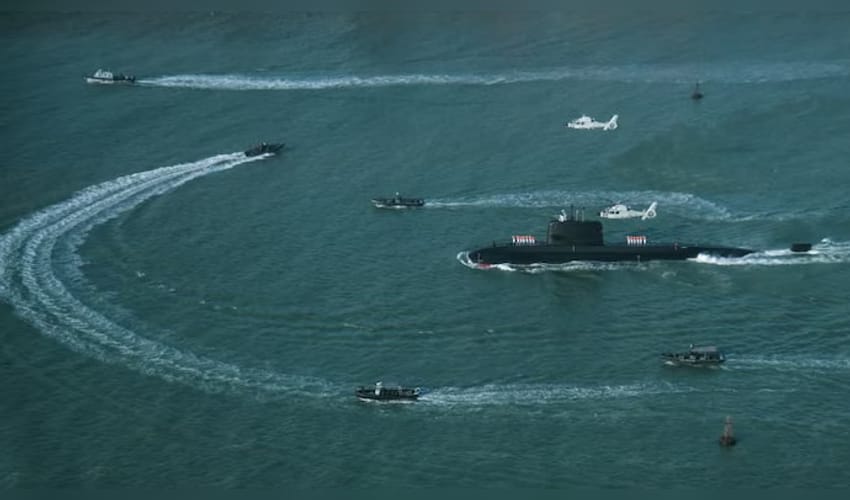

For decades, the Bay of Bengal has been viewed as a strategic space where India enjoyed considerable maritime influence. Positioned at the heart of the eastern Indian Ocean, the region serves as a critical gateway for trade, energy shipments, and naval operations. However, changing geopolitical dynamics, expanding naval partnerships, and advances in maritime technology are prompting analysts to reconsider whether this maritime landscape could become more contested in the future.
Pakistan's naval modernization efforts have attracted increasing attention in recent years. The induction of new submarines, advanced frigates, maritime surveillance systems, and long-range anti-ship capabilities has significantly enhanced the operational reach of the Pakistan Navy. While traditionally focused on the Arabian Sea and the western maritime front, questions are emerging about whether Islamabad could eventually project a limited but meaningful presence into the Bay of Bengal.
Such a move would not necessarily require a large fleet deployment. Modern naval warfare increasingly emphasizes stealth, intelligence gathering, and strategic signaling. A submarine operating discreetly in distant waters can generate significant strategic effects without ever being detected. The acquisition of modern submarine platforms and improved maritime domain awareness capabilities may provide Pakistan with greater flexibility than in previous decades.
The regional security environment is also evolving. Growing strategic cooperation between Pakistan and China has altered maritime calculations across the Indo-Pacific. China's expanding naval footprint, including regular deployments in the Indian Ocean Region, has created new opportunities for coordination, information sharing, and logistical support. While there is no public indication of a permanent Pakistan Navy presence in the Bay of Bengal, future contingencies could see greater cooperation between friendly naval forces operating across multiple theaters.
For India, the Bay of Bengal remains vital to national security. The region hosts key naval facilities, supports maritime trade routes, and serves as a bridge to Southeast Asia through New Delhi's Act East policy. India's Eastern Naval Command maintains substantial capabilities designed to ensure maritime security and deter potential threats. Advanced surveillance networks, long-range maritime patrol aircraft, and growing anti-submarine warfare assets provide India with significant advantages in monitoring activities across the region.
Nevertheless, maritime competition is no longer solely determined by fleet size. Cyber capabilities, unmanned systems, satellite surveillance, and underwater warfare technologies are reshaping the balance of power. Smaller naval forces equipped with modern platforms can sometimes exert influence disproportionate to their size.
Any future Pakistan Navy activity in the Bay of Bengal would likely be shaped by broader regional developments rather than unilateral ambitions. Strategic competition among major powers, evolving security partnerships, and technological advancements will continue to redefine maritime dynamics throughout the Indian Ocean.
Ultimately, the question is not whether Pakistan can dominate the Bay of Bengal. Rather, it is whether emerging capabilities could allow Islamabad to occasionally operate in waters once considered beyond its practical reach. As naval modernization accelerates across South Asia, assumptions about uncontested maritime spaces are increasingly being challenged, making the Bay of Bengal an area of growing strategic interest for all regional stakeholders.
Disclaimer: This image is taken from India Today.



