



Asia In News
Satellite Images Show China Deploying 11 Stealth Jets Near India, Raising Strategic Concerns
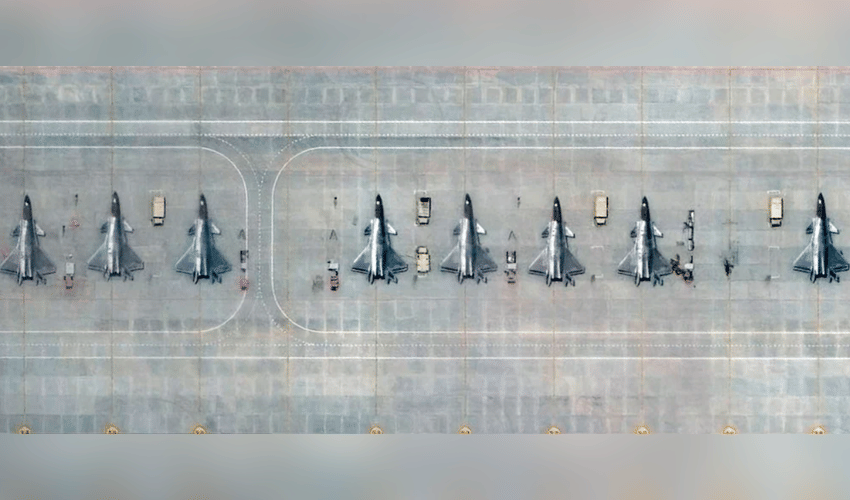

Fresh satellite imagery has revealed that China has deployed at least 11 of its advanced J-20 stealth fighter aircraft at airbases facing India, highlighting Beijing's continued military build-up along the Himalayan frontier. The development has drawn attention from defence experts, who say India's own fifth-generation fighter capability is still several years away.
The satellite images, reportedly captured over recent weeks, show J-20 stealth fighters stationed at key Chinese airbases, including Hotan in Xinjiang and Damxung in Tibet. Both locations are strategically positioned to support air operations along the Line of Actual Control (LAC), where India and China have remained locked in a prolonged military standoff since 2020.
The J-20, often referred to as China's answer to the American F-22 and F-35, is designed with stealth technology that reduces its radar signature, allowing it to operate with greater survivability in contested airspace. Equipped with advanced sensors, long-range missiles and modern avionics, the aircraft represents one of the most capable assets in the People's Liberation Army Air Force (PLAAF).
While the deployment does not necessarily indicate an imminent military confrontation, analysts believe it reflects China's intent to strengthen its air combat capabilities in regions bordering India. Operating stealth fighters from high-altitude bases also demonstrates growing confidence in the PLAAF's ability to sustain advanced operations under challenging conditions.
India, meanwhile, continues to rely on a mix of 4th and 4.5-generation fighter aircraft, including the Rafale, Su-30MKI, Mirage 2000, MiG-29 and the indigenous LCA Tejas. These aircraft are backed by a network of air defence systems, airborne warning platforms and indigenous long-range Astra missiles, making the Indian Air Force one of the most capable in the region.
India currently does not possess an operational fifth-generation stealth fighter. The country's indigenous Advanced Medium Combat Aircraft (AMCA) programme is expected to fill that gap, but the project remains under development and is unlikely to enter service for several years. Defence experts note that modern aerial warfare depends on much more than fighter aircraft alone. Space-based surveillance, electronic warfare, airborne early warning systems, secure communications and integrated missile defences all play a crucial role in determining combat effectiveness. India has been steadily investing in these areas while also accelerating indigenous defence manufacturing.
The latest satellite findings come amid increasing military modernisation across Asia, where regional powers are investing heavily in advanced aircraft, drones and missile systems. China's expanding fleet of stealth fighters is seen as part of its broader effort to project military strength and enhance its strategic posture along multiple fronts. The development underscores the importance of speeding up next-generation defence projects while continuing to upgrade its existing fleet and surveillance capabilities. As regional competition intensifies, military experts believe technological advancement and rapid modernisation will remain central to maintaining a credible deterrence posture.