



Technology
India and Germany to Co-Develop 5-Tonne AeroForce X UAV for Long-Endurance ISR Missions
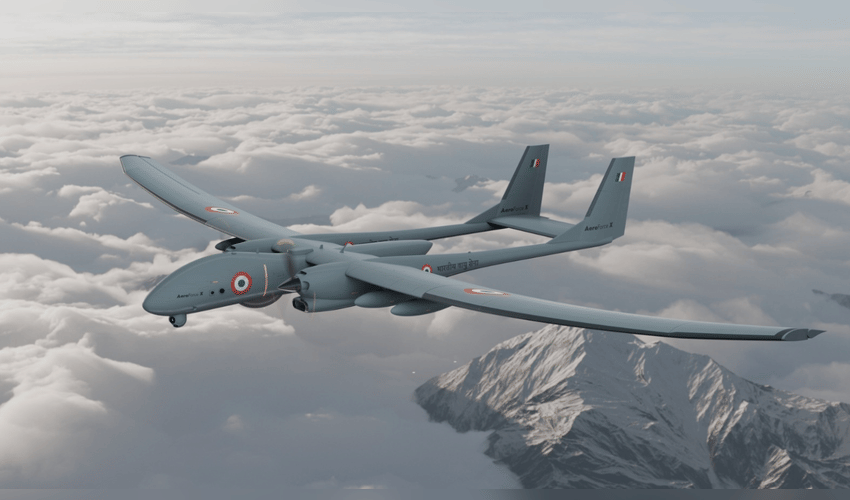

India and Germany are set to jointly develop a 5‑tonne unmanned aerial vehicle (UAV) platform called AeroForce X, marking a significant step in their defence‑technology cooperation. The project will pair German sensor and mission‑systems expertise with Indian engineering and manufacturing capabilities to create a high‑endurance, long‑range surveillance drone tailored to Indian operational needs.
The collaboration is being led by German firm Aerodata and Indian aerospace startup Dynauton, which have formalized a German‑Indian partnership for the unmanned air vehicle platform. The AeroForce X is being designed as a medium‑altitude, long‑endurance (MALE) UAV weighing around 5 tonnes, capable of flying for up to 40 hours in a single mission.
This endurance makes it suitable for extended intelligence, surveillance and reconnaissance (ISR) sorties over land and sea, including difficult terrain such as the Himalayas and vast maritime zones in the Indian Ocean region. The platform will be scalable to carry different sensor suites, including radar, electro‑optical/infrared systems, and electronic‑intelligence (ELINT) packages, depending on the mission.
The AeroForce X initiative comes on the heels of a broader defence industrial cooperation roadmap signed between India and Germany in early 2026. That agreement promotes joint development and co‑production of platforms such as submarines and armed UAVs, shifting the relationship from a traditional buyer–seller model toward deeper industrial and technology integration. The project offers faster access to advanced sensor and mission‑system integration know‑how, while giving German firms like Aerodata a foothold in India’s rapidly growing defence‑electronics and UAV ecosystem. It also opens potential export avenues for the platform into other emerging‑market armed forces that need cost‑effective, long‑endurance ISR assets.
A 5‑tonne UAV with 40‑hour endurance can cover large stretches of India’s northern and western borders, as well as key maritime approaches, reducing the need for frequent aircraft rotations and refuelling. Such a platform can support border surveillance, maritime domain awareness, anti‑piracy operations, and other security missions where persistent coverage is critical.
The AeroForce X could evolve into a multi‑role system by integrating electronic‑warfare payloads or even limited strike capabilities, aligning with India’s broader push to field armed UAVs and networked digital‑battlefield architectures. The project also dovetails with India’s “atmanirbhar” (self‑reliant) defence manufacturing push, where foreign partnerships act as technology enablers rather than permanent dependencies.
Beyond the immediate hardware, the collaboration is expected to strengthen India’s domestic UAV supply chain. Dynauton brings engineering and manufacturing experience in unmanned systems, while Aerodata contributes deep expertise in airborne surveillance and reconnaissance integration. The partnership could accelerate local production of airframes, avionics, and ground‑control infrastructure, while nurturing design, testing, and systems‑engineering capabilities for future indigenous platforms.
As India invests heavily in AI‑driven drone swarms and networked command structures, a capable MALE‑class UAV like AeroForce X can serve both as a sensor node and a communications relay, feeding real‑time data into joint operational headquarters. Seen together, the Indo‑German UAV project is not just about building another drone—it is about shaping how India monitors its borders, projects power, and integrates its growing unmanned fleet into the future battlefield.