



News
India and Austria boost ties, agree on a counter-terrorism group during Chancellor Stocker's visit.
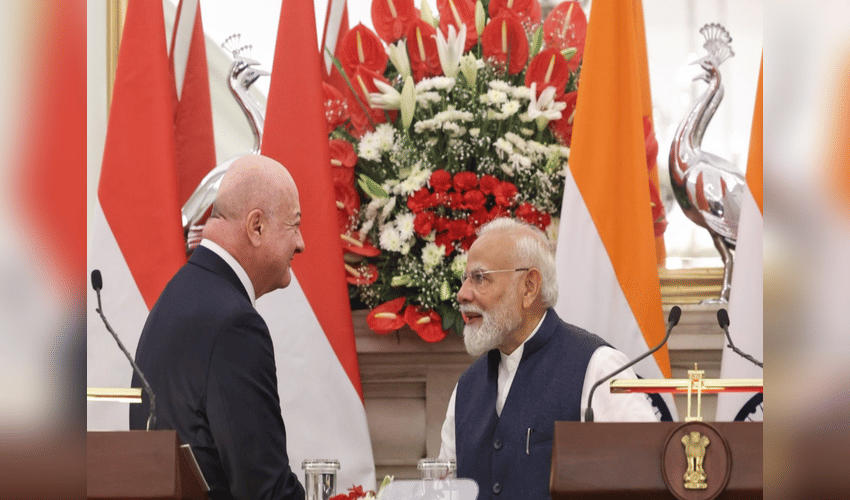

India and Austria on Thursday announced 15 key outcomes during Federal Chancellor Christian Stocker’s four-day official visit to India. The discussions, held with Prime Minister Narendra Modi in New Delhi, focused on strengthening cooperation in defence, technology, trade, innovation and skill development, with a special emphasis on creating a Joint Working Group on Counter-Terrorism.
This marks the first visit by an Austrian Chancellor to India in 40 years. According to the Ministry of External Affairs, both countries agreed to expand collaboration across strategic sectors and reaffirmed their shared commitment to fighting terrorism in all its forms, including cross-border threats. A major outcome of the talks was a Letter of Intent to establish a Joint Working Group on Counter-Terrorism to boost coordination against global terror challenges. In the defence sector, another Letter of Intent aims to deepen cooperation through joint industrial projects, policy exchanges, training, and capacity-building initiatives.
The two sides also signed an Agreement on Audiovisual Co-production to promote collaboration between their film industries and encourage cultural exchange through joint projects. To improve economic engagement, they introduced a Fast Track Mechanism to support Indian and Austrian businesses by addressing investor concerns and improving ease of doing business.
In the field of food safety, a Memorandum of Understanding was signed between AGES Austria and India’s FSSAI to enhance cooperation in regulatory practices, standards and scientific exchange. A separate agreement on vocational education and skills development will promote apprenticeships, knowledge sharing, and mutual recognition of qualifications. Additional initiatives include renewed cooperation in road infrastructure, expansion of the India-Austria Startup Bridge, and the launch of an Institutional Cybersecurity Dialogue. Both countries also agreed to work together in emerging technologies such as quantum computing, machine learning, advanced materials, and wastewater management.
Further plans include a bilateral space industry seminar in Vienna in 2026, a Working Holiday Programme, and a structured dialogue on higher education cooperation. After the meeting, Prime Minister Modi described the discussions as highly productive in a post on X, noting that Austria’s Chancellor chose India as his first destination outside Europe after taking office and highlighting the significance of the long gap since the last Austrian Chancellor visit. He also emphasized strong potential for collaboration in defence, semiconductors, startups, and future technologies.
The Ministry of External Affairs stated that the leaders reviewed the entire scope of bilateral relations, including trade, investment, innovation, green technologies, education, and people-to-people ties, along with global and regional issues. The visit is seen as timely, especially in light of the India-EU Free Trade Agreement, which is expected to open new avenues for trade, manufacturing, investment, and employment. The 15 outcomes signal a stronger, innovation-focused partnership between India and Austria moving forward.



