



Military
China's growing influence complicates India's bid to lead the Global South, says Army Chief.
Published On Mon, 17 Mar 2025
Neha Malhotra
1 Views
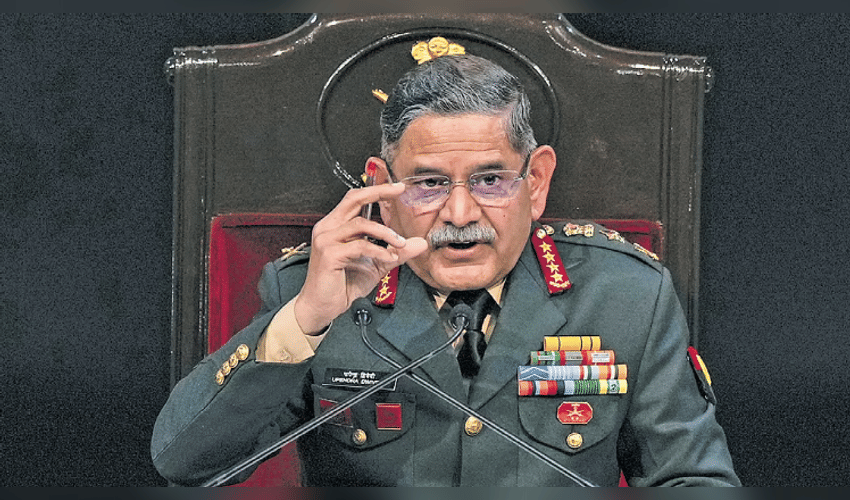

The rise of China as a major economic and strategic power has introduced new complexities and intensified competition, making it harder for India to assert itself as a natural leader of the Global South, said Army Chief General Upendra Dwivedi on Sunday. Speaking at the Gen Bipin Rawat Memorial Lecture in Delhi, Gen Dwivedi emphasized that Prime Minister Narendra Modi's vision of Viksit Bharat 2047 presents a significant opportunity for India to claim its rightful place in the evolving global security landscape.
He also touched upon the close ties between China and Pakistan, describing their "near absolute collusivity" as a growing security concern for India. Referring to the two-front challenge posed by both nations, he reiterated that India must acknowledge and prepare for this reality. The Army chief cautioned against falling into the Thucydides Trap, a concept that suggests rising powers inevitably come into conflict with established ones. He posed a critical question: Can India, with pressing social sector needs, afford to be drawn into such a geopolitical rivalry? At the same time, can it ignore the volatility of its neighborhood?
Reflecting on the legacy of India’s first Chief of Defence Staff, the late General Bipin Rawat, Gen Dwivedi highlighted his strategic foresight. He recalled Rawat's warning that with unresolved borders in both the north and west, India must be prepared for conflicts on multiple fronts. Discussing recent global conflicts, including those in Ukraine and Gaza, he observed how nations have aligned themselves based on realism, idealism, or even religious motivations. He also pointed to broader global threats such as terrorism, radicalization, cyber warfare, and a growing shift from democracy to authoritarianism.
Gen Dwivedi analyzed the evolving world order, noting China's challenge to the established system through initiatives like the Belt and Road project. Meanwhile, the U.S. has reinforced alliances like AUKUS and Quad, Europe is struggling to balance its human rights principles with its diplomatic engagements, and the Global South is asserting itself in favor of a multipolar world.
Amid these shifting dynamics, he highlighted India's strategic shift from a traditional policy of non-alignment to one of multi-alignment, reflecting both its growing strength and the expectations placed upon it. He stressed that in today's security environment, merely doing more is not enough—India must think differently and act innovatively. True security, he argued, is not just about military deterrence but a combination of diplomatic, informational, military, economic, and technological (DIME-T) strength.
India’s future security framework, he said, must integrate civilian and military capabilities, build a self-reliant defense industry, and leverage dual-use technologies. He also underscored the increasing importance of technological superiority, calling it the new currency of deterrence, and noted that data has become a crucial asset in both trade and security.
Finally, Gen Dwivedi warned that the growing militarization of space, particularly led by China, is adding new risks, including an increase in orbital debris. His speech underscored the urgent need for India to reimagine its security strategy, balancing its developmental aspirations with its responsibility to safeguard national interests in an increasingly unpredictable world.
Disclaimer: This image is taken from PTI



