



Military
An Indian Navy P-8I aircraft has landed at Joint Base Pearl Harbor-Hickam in Hawaii to take part in RIMPAC 2026.
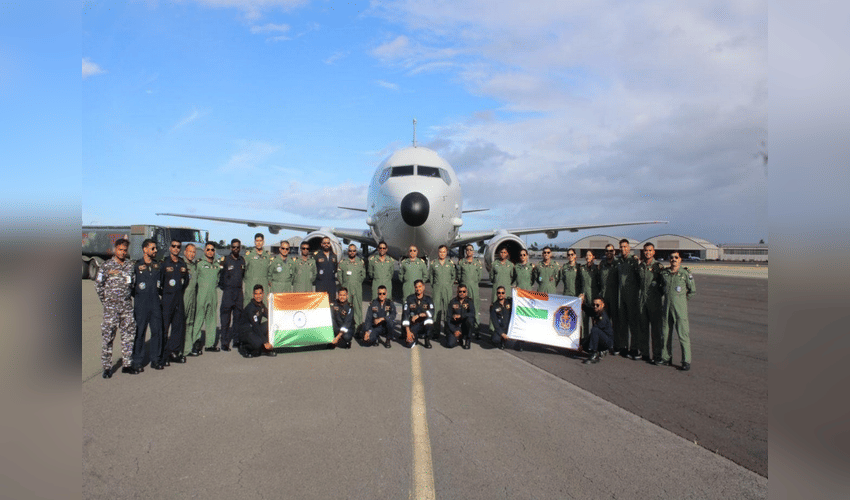

The Indian Navy’s P-8I Long Range Maritime Reconnaissance and Anti-Submarine Warfare aircraft has reached Joint Base Pearl Harbor–Hickam in Honolulu, Hawaii, to take part in the 30th edition of the Rim of the Pacific (RIMPAC) exercise. Joint Base Pearl Harbor–Hickam is a US military installation located on the island of Oahu, Hawaii.
In a post on X, Indian Navy spokesperson Captain Vivek Madhwal from Naval Headquarters said India’s participation in one of the world’s largest multinational maritime exercises reflects the Navy’s commitment to a “free, open, inclusive, and rules-based Indo-Pacific.” The Navy also described the deployment as a “Bridge of Friendship” between India and the United States.
The post further stated that the P-8I aircraft has arrived in Honolulu for RIMPAC 2026, one of the largest multinational maritime exercises, scheduled from 1 to 31 July 2026. It highlighted that the deployment strengthens interoperability, maritime domain awareness, and operational cooperation with partner navies while reaffirming India’s commitment to a rules-based Indo-Pacific region. The Indian Navy also participated in Exercise Sea Dragon 2026 at Andersen Air Force Base in Guam with its P-8I maritime patrol aircraft, according to a statement from the US Department of War. The P-8I had previously taken part in RIMPAC 2024 at Joint Base Pearl Harbor–Hickam as well.
During RIMPAC 2024, the Indian Navy shared visuals of the P-8I landing at Pearl Harbor after completing anti-submarine missions alongside the US Navy and other participating forces. The Indian multirole stealth frigate INS Shivalik, deployed in the South China Sea and North Pacific, also participated in the 29th edition of RIMPAC that year.
According to the US Department of War, RIMPAC is the world’s largest international maritime exercise, which began on June 24 around the Hawaiian Islands. The 30th edition this year brings together around 30,000 personnel from multiple nations, offering a platform to enhance collective readiness and cooperation for a free and open Indo-Pacific.
First conducted in 1971, the biennial exercise runs through July 31 and includes a wide range of operations such as amphibious warfare, gunnery and missile drills, anti-submarine warfare, air defence, humanitarian assistance and disaster response, counter-piracy, mine clearance, explosive ordnance disposal, and diving and salvage operations.



