



Technology
Trump Calls White House 'DronePort' a Key Military Asset After Court Halts Construction
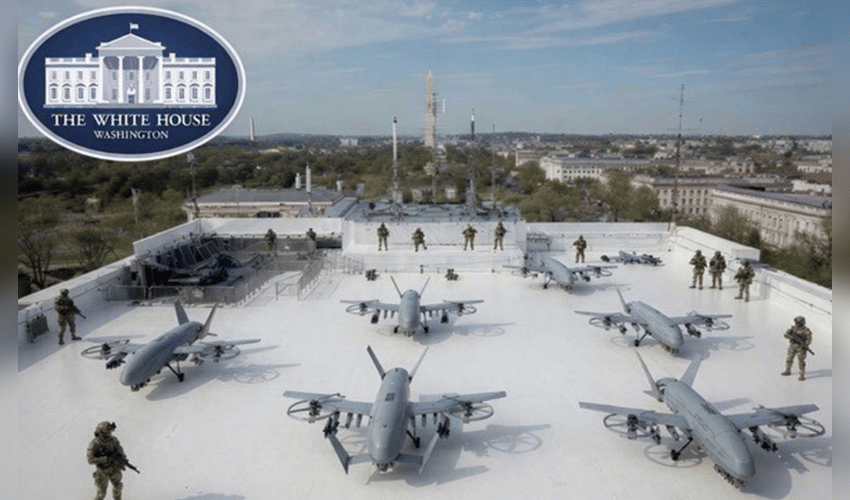

US President Donald Trump has renewed his defence of the proposed White House ballroom and military complex, describing a planned rooftop “DronePort” as a major military and national security asset. Trump shared an illustration of the proposed DronePort on his Truth Social account. The graphic depicts several military drones positioned on a rooftop installation above the White House, with armed security personnel shown guarding the facility. The Washington Monument and the broader capital skyline can be seen in the background.
Highlighting the security role of the proposed facility, Trump said the DronePort would strengthen protection around Washington, DC, and provide an additional layer of security for future US presidents. “This great and very important military asset sits atop the heavily protected Ballroom at the White House,” Trump wrote, arguing that the facility would contribute to national security and presidential protection.
His comments came as the administration faces a major legal setback over the planned ballroom. A divided federal appeals court has blocked above-ground construction of the project, ruling that the administration needs approval from Congress before moving ahead. Trump has strongly criticised the decision, previously calling it both a “National Security Threat” and a “National disgrace.” He has also confirmed that his administration intends to challenge the ruling before the US Supreme Court.
In another Truth Social post, Trump objected to the court’s interpretation of presidential authority over the White House grounds. Referring to the judges who ruled against the administration, he argued that elected presidents have the authority to renovate, strengthen and protect the presidential residence.
Trump maintained that the proposed development is not simply a ballroom project but includes security and military infrastructure that he considers essential to protecting the White House. The legal dispute centres on the administration’s plan to replace the White House East Wing with a ballroom measuring roughly 89,000 square feet. The broader proposal includes underground security infrastructure as well as the rooftop DronePort.
The US Court of Appeals for the District of Columbia Circuit ruled 2-1 that the administration cannot continue with the major above-ground construction without congressional authorisation. The court emphasised that a project of such scale is a matter for Congress rather than something the executive branch can undertake on its own.
The court has temporarily paused the effect of its ruling for two weeks, allowing the Trump administration time to seek further legal relief, including an appeal to the Supreme Court. For now, work on the underground security bunker can continue, while construction of the above-ground ballroom remains blocked without congressional approval. The dispute could ultimately become a broader test of presidential authority over the White House complex. It also places Trump’s argument about modernising presidential security—including the proposed DronePort—at the centre of an increasingly high-profile legal and political battle.



