



Military
TEJAS Mk-1A Debuts Mid-Board Drop Tank Configuration, Hinting at Greater Firepower for Future Mk-2 Fighter
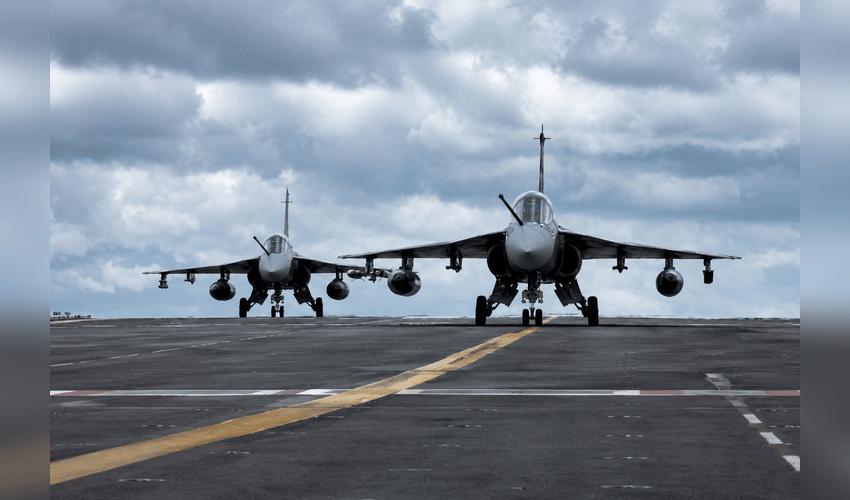

India's indigenous Light Combat Aircraft (LCA) Tejas programme appears to have taken another step toward enhancing its combat capabilities after the Tejas Mk-1A was recently seen sporting a new mid-board drop tank configuration. Defence analysts believe the revised arrangement could pave the way for the integration of twin-launch racks for the indigenous ASTRA beyond-visual-range (BVR) air-to-air missile on the upcoming Tejas Mk-2.
The latest configuration has generated considerable interest among aviation enthusiasts and defence experts, as it suggests that Indian engineers are continuing to refine the aircraft's weapons-carrying capability while improving operational flexibility. The repositioning of the external fuel tanks closer to the fuselage is expected to free up additional underwing hardpoints that are typically occupied by drop tanks. This would allow future variants, particularly the larger and more powerful Tejas Mk-2, to carry a greater number of air-to-air missiles without compromising the aircraft's range.
The new arrangement could enable the use of twin-launch missile racks, allowing two ASTRA missiles to be mounted on a single weapon station instead of one. Such a configuration would significantly increase the fighter's missile loadout, giving pilots more engagement options during beyond-visual-range combat missions.
Military aviation experts note that modern air combat increasingly relies on long-range missile engagements, making missile capacity a critical factor in determining a fighter aircraft's effectiveness. Carrying additional BVR missiles allows pilots to engage multiple hostile aircraft while retaining sufficient weapons for prolonged engagements.
The Tejas Mk-1A itself represents a major improvement over the earlier Mk-1 variant. It features an Active Electronically Scanned Array (AESA) radar, an upgraded electronic warfare suite, improved maintenance features, and compatibility with a wider range of indigenous and imported weapons. The aircraft is expected to become a key component of the Indian Air Force's future fighter fleet as deliveries continue over the coming years.
The lessons learned from the Mk-1A are also expected to influence the development of the Tejas Mk-2, which is being designed as a medium-weight multirole fighter with a more powerful engine, increased payload capacity, longer combat radius, and enhanced survivability. The aircraft is intended to replace several ageing fighter platforms currently serving in the Indian Air Force.
The potential integration of twin-launch ASTRA racks aligns with India's broader efforts to strengthen indigenous defence manufacturing under the Atmanirbhar Bharat initiative. Developed by the Defence Research and Development Organisation (DRDO), the ASTRA missile family is steadily becoming a cornerstone of India's air-to-air combat capability and is being integrated across multiple fighter platforms.
Beyond increasing firepower, the revised pylon configuration could also offer mission planners greater flexibility by allowing aircraft to carry a balanced mix of fuel tanks, missiles, precision-guided munitions, and electronic warfare pods based on operational requirements. While defence authorities have not officially confirmed that the new drop tank arrangement is specifically intended to support twin ASTRA launchers, the configuration has fuelled speculation that the Tejas programme is already laying the groundwork for future capability enhancements.
As development of the Tejas Mk-2 progresses, such incremental design refinements are expected to play an important role in improving the aircraft's combat effectiveness. If adopted in production, the new weapons configuration could provide the Indian Air Force with a more heavily armed indigenous fighter capable of responding to evolving regional security challenges while reducing reliance on foreign weapon systems.