



Military
Pralay Missile Boosts India's Conventional Strike Capability Amid Evolving Security Challenges

The large-scale deployment of ballistic missiles by Iran in the ongoing West Asian conflict has highlighted how these weapons are increasingly being used for conventional warfare rather than solely as nuclear delivery systems, a recent TOI report noted. Traditionally linked with carrying nuclear warheads, ballistic missiles are now being equipped with conventional high-explosive payloads capable of striking targets deep within enemy territory with high precision and destructive impact.
A similar shift has been visible in the Russia-Ukraine war, where Moscow has used the Oreshnik Intermediate-Range Ballistic Missile (IRBM) against Ukrainian targets. The development reflects a broader global trend in which ballistic missiles are becoming key tools for long-range conventional military operations. One of the major challenges posed by these systems is their extreme speed during the final stage of flight, which makes interception highly difficult. In response to the growing threat from Iranian missile attacks, the United States has reportedly repositioned Terminal High Altitude Area Defence (THAAD) systems from different regions to help shield allied nations.
The increasing difficulty in neutralising ballistic missiles has amplified the importance of advanced missile defence networks and created fresh strategic concerns for countries facing missile-equipped adversaries. India, meanwhile, has developed an extensive ballistic missile arsenal designed to address both strategic and battlefield requirements. The Agni missile family remains central to India’s long-range nuclear deterrence capability, while the submarine-launched K-series missiles strengthen the country’s second-strike capacity by ensuring a survivable sea-based deterrent.
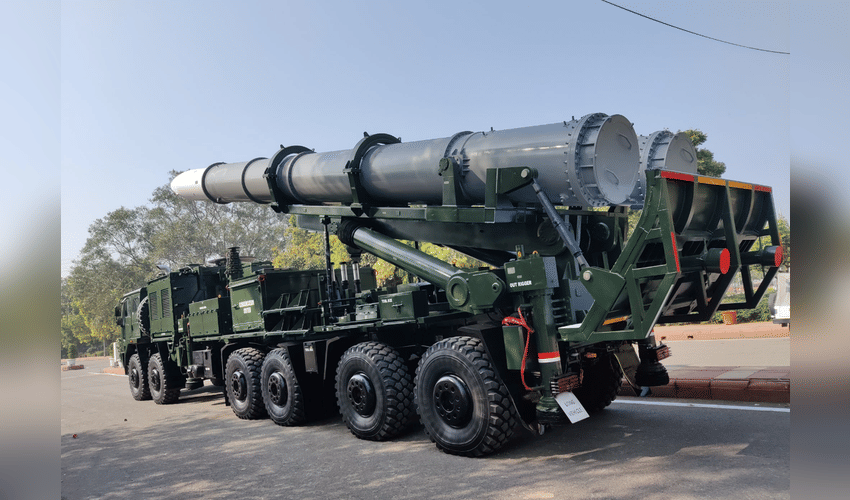
Together, these systems support India’s doctrine of minimum credible deterrence and align with its no-first-use nuclear policy. For conventional battlefield roles, India has focused on the Pralay missile, a short-range tactical ballistic missile developed by the Defence Research and Development Organisation (DRDO). Drawing technology from both the Prahaar missile programme and the Prithvi Defence Vehicle (PDV), Pralay was designed to provide India with a precision-strike option that operates outside the nuclear framework.
The missile is capable of carrying multiple types of warheads weighing between 350 kg and 1,000 kg, including fragmentation, penetration, and runway-denial payloads. With a strike range of up to 500 kilometres, Pralay is often compared with systems such as China’s Dongfeng-12 and Russia’s Iskander missile. Equipped with a solid-fuel rocket motor, the road-mobile missile can be deployed quickly and launched with minimal preparation time. Its ability to execute terminal manoeuvres during the final phase of flight significantly improves its chances of evading enemy air defence systems.
Pralay is designed to target high-value military infrastructure, including radar stations, communication centres, command facilities, and airbases. Defence planners also view the missile as part of a larger integrated strike ecosystem alongside systems such as the Nirbhay cruise missile, BrahMos supersonic missile, and the Pinaka rocket launcher. This layered strike architecture gives India greater operational flexibility and enhances its conventional deterrence capability across multiple combat scenarios.
The induction of Pralay reflects India's broader military modernisation strategy aimed at strengthening precision conventional strike options in response to changing regional security dynamics. By developing a missile capable of carrying out deep conventional strikes without triggering nuclear escalation, India gains a more flexible response capability while maintaining escalation control during potential conflicts. The growing emphasis on systems like Pralay also mirrors global military trends, where ballistic missiles are increasingly being adapted for conventional combat roles, as demonstrated in recent conflicts involving Iran and Russia.
Disclaimer: This image is taken from Indian Defence Research Wing.



