



World
37 Years of Lies: The Tiananmen Square Story Beijing Cannot Kill
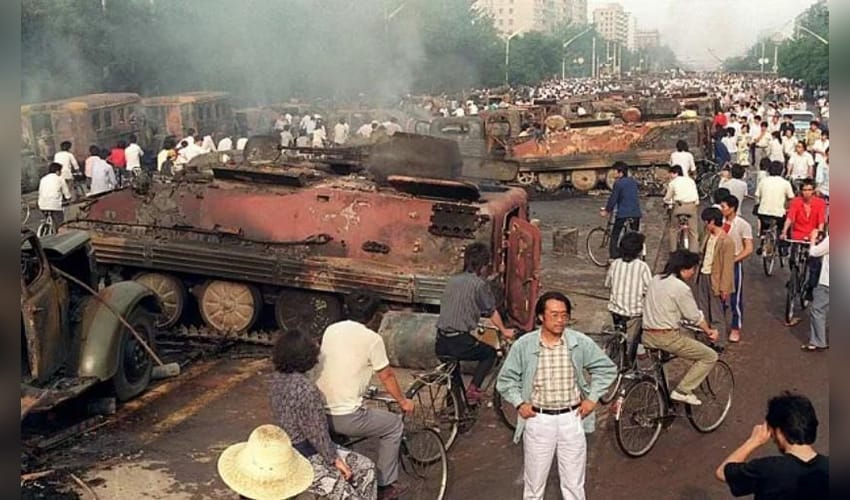

Thirty-seven years after Chinese tanks rolled through the streets of Beijing, the battle for Tiananmen Square has shifted from the physical to the epistemological. The question is no longer what happened on the night of June 3 to 4, 1989, when soldiers with live ammunition forced their way through crowds to clear the square, killing hundreds and possibly thousands. The question now is whether the truth of what happened can survive the most sophisticated erasure operation in modern political history, one that spans textbooks, social media platforms, artificial intelligence, and the physical graves of the dead. The answer, in 2026, is less certain than it has ever been.
The Great Forgetting Inside China
Inside the People's Republic, Tiananmen does not exist. It is not taught in schools. It does not appear in officially approved history textbooks. No books examine it. When NPR correspondent Louisa Lim tested the limits of this amnesia, she found that only 15 out of 100 students at four Beijing universities could identify the iconic photograph of Tank Man, the lone figure standing before a column of armoured vehicles that became perhaps the most reproduced political image of the twentieth century. Some students told her the image was photoshopped. Others guessed it was from South Korea or Kosovo. The photograph was simply outside the architecture of their world.
The forgetting is not passive. It is manufactured and maintained at enormous cost. Every year in the days before June 4, the censorship machinery activates with precision. Keywords including "square," "tank," and "8964" are blocked across Chinese social media platforms. In 2025, WeChat users found they could not change their profile pictures on June 4; Tencent claimed the restriction was to "purify the online environment" during university entrance examinations, a deflection so transparent it prompted widespread mockery.
A leaked database revealed that China had built a sophisticated AI system trained on 133,000 examples of sensitive content, capable of detecting even subtle or indirect references to politically inconvenient events, far beyond the blunt keyword filters of earlier years. The censor no longer needs to read. It has been taught to think.
In 2026, the repression reached a new threshold of cruelty. For the first time in more than thirty years, families of victims were formally barred from visiting Wanan Cemetery, the Beijing burial ground where many of those killed in 1989 now rest. Members of the Tiananmen Mothers, an organisation that has spent decades compiling a verified list of the dead and pressing the government for accountability, received official notice from the Beijing Municipal Security Bureau that they would not be permitted on the premises, nor would they be allowed to read memorial tributes or publish photographs related to their grief. The families condemned this as a violation of China's own constitution and "basic human dignity". The state offered no response.
The Shrinking of Hong Kong
The vigil ended with the national security law imposed by Beijing on Hong Kong in June 2020. What followed was swift and methodical. The Hong Kong Alliance in Support of Patriotic Democratic Movements of China, the group that had organised the vigil for thirty-two consecutive years, was disbanded. Its leaders were arrested on charges of subversion. In 2021, nine activists received prison sentences of six to ten months for attending what had simply been a gathering in a public park. Universities removed sculptures and artworks commemorating the massacre under pressure from authorities. In May 2026, two prominent organisers, Lee Cheuk-yan and Chow Hang-tung, faced final arguments in their trial on charges of "inciting subversion" and were looking at sentences of up to ten years in prison. Their crime was lighting candles.
By June 2025, the policing of memory had reached an almost theatrical level of vigilance. In Causeway Bay near Victoria Park, officers took away two schoolgirls carrying flowers. A performance artist was compelled to move away from the park. Customs officials raided a shop selling small white candles. These are not the tools of a confident government. They are the tools of a frightened one.
Where the Flame Burns
Every space that closes in one place forces the memory to migrate outward. The diaspora and the democratic world have absorbed this displaced commemoration with growing intensity. In 2025, public memorials were held in more than 30 cities across Europe, North America, and Asia. In Taipei, hundreds gathered in Liberty Square, the renamed former memorial to another authoritarian leader, for a vigil organised largely by Hong Kongers who had relocated to Taiwan after the security law. Matthew Lai, one of the organisers, framed it plainly: "With Hong Kong no longer able to honor June 4th, we who have come to Taiwan bear an even greater duty to advocate for this cause". Taiwan remains the only place under Chinese cultural jurisdiction where such commemorations are not only permitted but actively supported by a government.
A Tiananmen Square massacre museum opened in New York in 2023, housing artefacts from the movement including a blood-stained shirt and objects used by student demonstrators. It replaced, in spirit if not in geography, the Tiananmen Museum that had operated in Hong Kong until authorities forced it to close in 2021. Online archives, encrypted file repositories, and GitHub repositories now carry digitised testimonies, photographs, and documents that activists have raced to preserve before platforms can be pressured to remove them. The Tiananmen Mothers group continues to publish an annual statement, signed by 108 members in 2025, calling for a full investigation, a complete list of the deceased, reparations for families, and legal accountability for those responsible.
When the Machine Learns to Lie
The most ominous development in the Tiananmen memory war is not censorship of the human kind. It is the training of artificial intelligence to replicate and extend it. In 2025, analysts testing Chinese AI systems including DeepSeek found that queries about Tiananmen triggered either complete refusals or responses consistent with party narratives, with no transparency to the user about why information was being withheld. A leaked database confirmed that Chinese authorities had built an LLM specifically designed to flag and suppress sensitive content at industrial scale, including content that referenced Tiananmen only indirectly through historical analogy or coded language.
This matters beyond China's borders. As Chinese AI models are adopted internationally, the censorship they embed travels with them. A user in São Paulo or Singapore asking a Chinese AI about June 4 may receive the same sanitised non-answer that a student in Beijing would. The erasure becomes portable, globalised, and structurally invisible. The user does not know what they are not being told. Radio Free Asia analyst and former journalist Xiao Qiang put the stakes plainly: "AI can only be as good or as bad as humanity. If it is trained on a corpus in which certain events do not exist, those events will not exist for it either". The risk is not merely that one government suppresses its own history. The risk is that the tools for suppressing history become indistinguishable from the tools for accessing it.
What Erasure Cannot Touch
History, even deliberately buried history, has a habit of surfacing through the cracks. Chinese netizens have spent years devising ever more inventive codes to reference June 4, from Roman numerals to special character strings, from yellow rubber duck arrangements to cigarette box formations that mirror the outline of Tank Man. The ingenuity of this resistance is itself a kind of testimony. People do not invent elaborate languages for events they do not care about.
The Tiananmen Mothers are now old. The youngest of the generation that gathered in the square is approaching or past sixty. The eyewitnesses are thinning. The physical archives are scattered, the Hong Kong vigil extinguished, the museums closed or exiled. And yet on June 4, 2026, the 37th anniversary of the massacre, families in Beijing were still trying to reach a cemetery, and authorities still felt compelled to stop them. That compulsion, the continued expenditure of state force to prevent elderly mothers from standing at their children's graves, is its own confession. Governments that are truly confident their version of history has prevailed do not need to post police at cemeteries.
Memory is not simply an act of sentiment. It is a political act, a claim about what happened and who is responsible. Every candle lit in Taipei, every archived document, every VPN-enabled scroll through a forbidden photograph is a counter-claim. The battle for Tiananmen is not over. In many ways, in the age of artificial intelligence and algorithmic censorship, it has barely begun.



