



Military
Army set to establish, operationalise first Integrated Battle Groups next month
Published On Mon, 29 Jun 2026
Fatima Hasan
41 Views
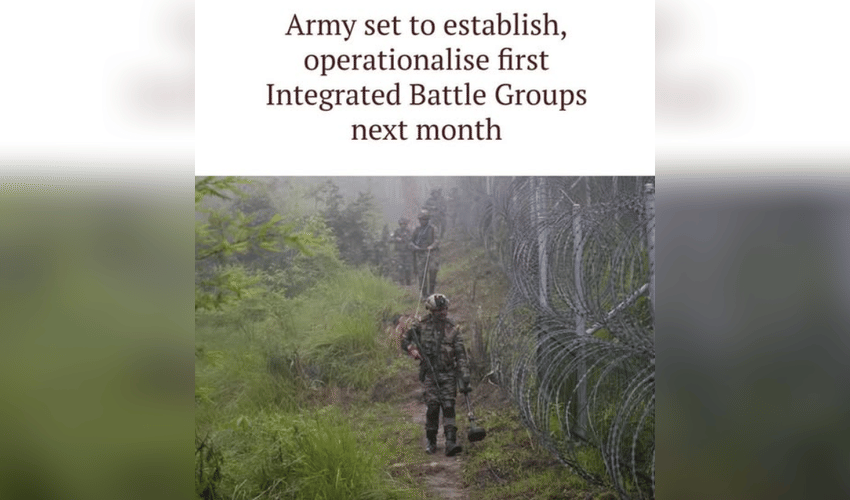

The Indian Army is preparing to roll out its first Integrated Battle Groups (IBGs) next month, marking one of the most significant structural reforms undertaken by the force in recent years. The move is expected to enhance the Armys ability to respond swiftly to emerging security challenges, particularly in difficult mountain terrain along the northern frontier. According to reports, the first batch of these formations will be carved out from the Panagarh-based XVII Mountain Strike Corps, which is primarily responsible for operations along the border with China.
Integrated Battle Groups are designed as compact, self-sufficient fighting formations that can be deployed much faster than traditional military divisions. Unlike conventional structures that require multiple formations to assemble before launching operations, an IBG combines infantry, artillery, engineers, logistics, medical support, and technical units under a single command. This integrated approach allows commanders to react quickly without waiting for larger formations to mobilize.
As part of the initial phase, the Army is expected to establish four Integrated Battle Groups along with a dedicated fire support group. Each IBG will consist of more than 5,000 personnel and will function as an independent combat formation capable of both offensive and defensive operations. The accompanying fire support group will provide long-range artillery and other battlefield support, strengthening the combat effectiveness of these units.
The concept of Integrated Battle Groups has been under discussion for several years. It was originally proposed during the tenure of former Army Chief General Bipin Rawat as part of a broader effort to modernize Indias military structure. Since then, the Army has tested the concept through multiple military exercises, refining the organization based on operational experience before moving toward full-scale implementation.
Military experts believe the biggest advantage of the IBG model lies in speed and flexibility. Traditional corps-level mobilization can involve tens of thousands of troops and significant logistical planning, which may delay deployment during fast-changing situations. In contrast, IBGs are designed to move rapidly with all essential combat and support elements already integrated, allowing them to respond to crises within a much shorter timeframe.
The new formations are expected to play a particularly important role in mountainous regions where terrain, weather, and infrastructure often complicate military operations. Self-contained units with dedicated engineering, logistics, communications, and medical capabilities can sustain operations more effectively in remote areas without relying heavily on external support.
The introduction of IBGs also aligns with the Indian Armys broader modernization programme, which includes restructuring field formations and integrating advanced technologies, precision weapons, and improved battlefield communications. Alongside initiatives such as Rudra brigades, Bhairav battalions, Divyastra batteries, and Shaktibaan units, the Army is steadily transforming into a force capable of responding to both conventional and emerging security threats with greater efficiency.
Defence analysts note that the restructuring reflects the changing nature of modern warfare, where rapid deployment, joint operations, and integrated combat capabilities are increasingly critical. Rather than relying solely on numerical strength, militaries around the world are focusing on highly mobile formations that can deliver decisive action in shorter timeframes.
The operationalisation of the first Integrated Battle Groups is therefore more than just an organizational change. It represents a shift in Indias military doctrine toward faster decision-making, improved battlefield coordination, and enhanced operational readiness. As these formations become active, they are expected to serve as a blueprint for similar restructuring across other Army commands in the coming years, strengthening Indias overall defence preparedness in an increasingly complex security environment.
Disclaimer: This image is taken from The Indian Express



