



World
West must take India more seriously in role to balance China: Report
Published On Fri, 31 Jul 2026
Asian Horizan Network
48 Views

New Delhi, July 31 (AHN) While for the last 20 years, Western governments have seen India as indispensable to the 21st-century order, they have not matched this with capital investment which has instead been flowing into China over the last 30 years and created a strategic adversary, according to an article published Lowy Institute, an Australian think tank.
The article highlights that India is not yet the anchor of an industrial alternative capable of balancing China. But it is the only country with the scale to become one.
The West is now trying to correct a compounded strategic error by relying on incremental corporate decisions. Companies are encouraged to adopt “China plus one”, but they face incentives that favour China which has better infrastructure such as power and ports, that rising industrial powers are still trying to build, the article written by Stephanie Campbell states.
“The policy failure is to mistake the accumulation of fragmented corporate decisions for strategic rebalancing. Governments now ask firms to bear the cost of reversing a concentration created by decades of collective investment and reinforced by Western policy,” the article observes.
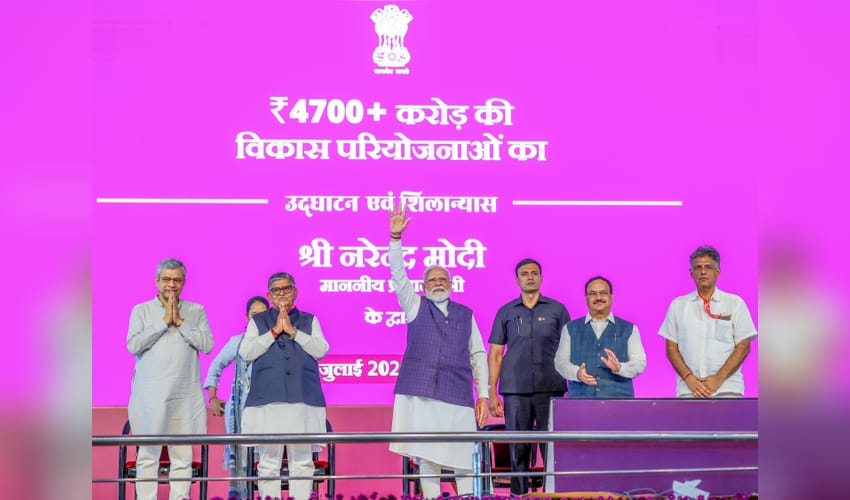
“PM Modi has spent more than a decade trying to convert India’s demographic and geopolitical scale into industrial power, with promising but uneven results. But India cannot become a second centre of industrial gravity through domestic reform alone,” the article further states.
It highlights that building a genuine alternative requires governments to alter the conditions under which private investment becomes commercially rational at scale, not to direct individual investments.
While Vietnam, Mexico, Indonesia and others can absorb specific industries and create valuable redundancy, India is the only country that can provide an industrial alternative at continental scale.
“The relevant choice is between a strategically autonomous India and continued industrial dependence on a strategic competitor. The West is demanding greater alignment from the country it needs to strengthen than it demanded from the adversary it allowed itself to depend upon,” the article observes.
It also highlights that although Australia cannot finance India’s industrial transformation, it can integrate critical minerals, energy and defence cooperation into a broader industrial strategy. India will remain strategically autonomous and – from the perspective of Western capitals – an imperfect partner. However, that imperfection is less dangerous than continued dependence on China.



