



Asia In News
Stronger India-Canada trade ties can bolster supply chain resilience: Report
Published On Thu, 28 May 2026
Asian Horizan Network
1 Views
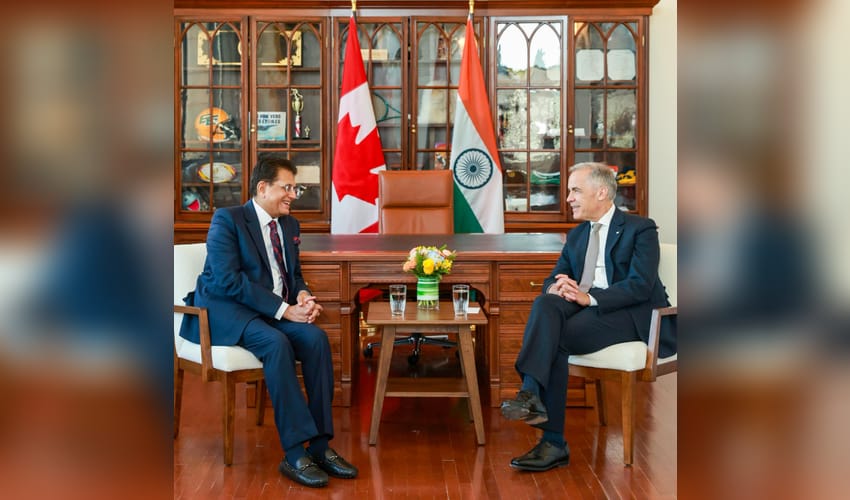

New Delhi, May 28 (AHN) A Canada-India trade agreement may seem modest in aggregate volume, but it is disproportionately important for Canada’s diversification strategy and North American supply chain resilience, especially in critical minerals, clean energy and knowledge intensive services, according to an article in One World Outlook.
Of late, bilateral commerce has grown into a mid-sized but still underexploited relationship. In fiscal year 2023–24, India–Canada merchandise trade reached about $8.4 billion, up slightly from $8.3 billion in 2022–23. In calendar year terms, bilateral trade in goods and services stood at $18.38 billion in 2023 and rose to roughly $23 billion in 2024, which shows that services now account for a significant share of the relationship, the article observes.
India imports pulses, fertilisers, newsprint, wood pulp, and industrial chemicals from Canada, creating concentrated dependencies in specific food security and input intensive sectors.
On the export side, India ships gems and jewellery, pharmaceutical products, readymade garments, organic chemicals and light engineering goods to Canada, reflecting India’s role as a diversified manufacturing and processing hub rather than a simple commodity supplier.
Services are where the bilateral relationship has grown most dynamically and where an Early Progress Trade Agreement (EPTA) or Comprehensive Economic Partnership Agreement (CEPA) EPTA/CEPA could deliver the highest value added gains for Canada and the United States.
Canada’s services exports to India account for only about 1 per cent of its total services exports, whereas services imports from India have climbed to an estimated 3.5 per cent of Canada’s total services imports, implying rising Canadian reliance on Indian IT, professional, and back-office capabilities, the article states.
For Ottawa, the strategic value of an India deal lies less in raw volume and more in diversification, away from an overwhelming dependence on the United States and a fraught but still sizable relationship with China. Global Affairs Canada has explicitly identified India as a priority partner within its Indo Pacific strategy, with an ambition to double two-way trade with India by 2030, the article points out.
It highlights that on the Indian side, sustained high growth and surging energy demand anchor the economic rationale for deeper engagement. Canada’s natural resources ministry explicitly notes that India is expected to account for the largest growth in global energy demand through 2030, positioning it as a key long term market for Canadian liquefied natural gas (LNG), crude, and other fuels.
India’s rapid electrification, ambitious renewable energy targets, and expanding middle class also create demand for critical minerals, advanced manufacturing inputs, and aerospace technology that Canada can competitively supply.
Institutionally, New Delhi and Ottawa have converged on a two-step architecture: a limited EPTA, followed by a comprehensive CEPA. In March 2022, ministers formally agreed to re-launch CEPA negotiations while pursuing an interim Early Progress Trade Agreement covering goods, services, investment, rules of origin, sanitary and phytosanitary (SPS) measures, technical barriers to trade, and dispute settlement, the article added.



