



Lifestyle
Rajasthan post-delivery complications: Questions over drug quality as women suffer infections, kidney issues
Published On Tue, 23 Jun 2026
Archana Sharma
3 Views

Jaipur, June 23 (AHN) What should have been a moment of joy for several families in Rajasthan has turned into a prolonged medical crisis, as mothers who survived childbirth are now battling life-threatening complications -- raising serious questions about the quality of medicines used in government hospitals.
The latest cases from Jodhpur have revived concerns sparked earlier in Kota and Bikaner. Eight women who underwent caesarean sections at Paota District Hospital in Jodhpur developed severe complications soon after surgery, including infections, uncontrolled bleeding, falling blood pressure and kidney-related issues.
Two women had to be shifted to intensive care, while one was referred to AIIMS Jodhpur as her condition deteriorated. The incident comes months after a far more devastating episode in Kota, where five women died following post-delivery complications linked to kidney failure. Several survivors continue to undergo regular dialysis, their lives permanently altered after what should have been a routine childbirth procedure.
Bikaner too witnessed similar cases with two women dead, adding to growing fears about the safety of treatment being provided in government hospitals. As investigators collect blood, urine, medicine, injection and IV fluid samples for testing, a disturbing question is increasingly being raised: Are substandard medicines putting patients at risk?
Leader of Opposition Tika Ram Jully has directly questioned the state's medicine procurement system, alleging that an excessive focus on cost-cutting may have compromised quality.
"Medicines are being purchased at discounts of up to 80 per cent. When procurement is driven solely by the lowest price, questions naturally arise about quality. Yet nobody in the system appears willing to examine this seriously," Jully told AHN.
He demanded an independent investigation into the entire supply chain, asking who procured the medicines, who approved them, who tested them, and how they reached patients.
"This cannot be dismissed as routine negligence. If lives are lost due to substandard medicines or failures in quality control, those responsible must face strict legal action," he added.
Meanwhile, a senior official told AHN that substandard drugs have emerged as a big challenge for the state government. "Many drug companies have emerged in the last few years; however, the quality of these drugs has fallen. Now, it's quite a difficult task to check the quality of so many companies. Meanwhile, this number is increasing as there is a huge profit margin in the drug industry," he said.
Former Chief Minister Ashok Gehlot also echoed the concerns while recalling his visits to affected families. "The first incident occurred in Kota, where five women lost their lives. I met the affected women personally. Many have suffered kidney failure. Some now require dialysis three times a week, others twice. Imagine the pain of a mother who has just delivered a child and is told she may need lifelong dialysis or even a kidney transplant," Gehlot said.
Referring to the cases in Bikaner and Jodhpur, Gehlot questioned how such incidents could continue to occur despite repeated warnings. "Now eight women in Jodhpur have developed severe infections. The government still appears asleep. Families are terrified. Husbands and brothers asked me what would happen after these women are discharged. Who will care for them if complications continue? What guarantee does the government offer?" he said.
Meanwhile, the government has defended its healthcare system. Health Minister Gajendra Singh Khimsar said the incidents in Kota, Bikaner and Jodhpur were different in nature and noted that government hospitals often receive complicated referral cases after patients face difficulties elsewhere (Yahan mareej dhakka khakar hi aate hain), he added.
"Jodhpur incident should not be linked to the separate incidents reported in Bikaner and Kota, as each case has its own circumstances and is being investigated independently."
Highlighting the performance of public healthcare institutions, he stated that government hospitals maintain a delivery success rate of 99.99 per cent, reflecting the dedication of medical professionals and the effectiveness of maternal healthcare services across the state.
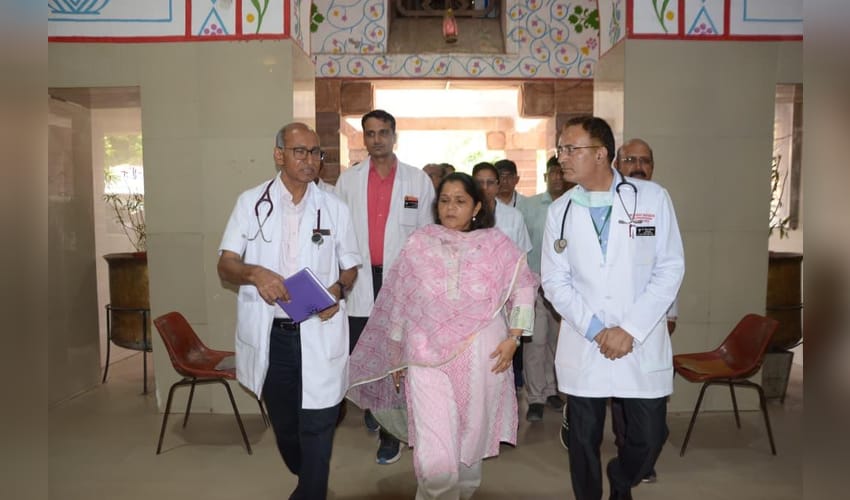
Meanwhile, as concern spread, Jodhpur District Collector Alok Ranjan visited Paota District Hospital and reviewed medical arrangements. He directed officials to ensure there was no negligence in patient care and instructed doctors to provide all necessary treatment and facilities on priority.
Dr B.S. Jodha, Principal of Dr SN Medical College, said the surgeries had been conducted on Saturday, after which several women developed unusually high body temperatures. "Two patients developed serious complications. One experienced significant blood pressure issues, while another suffered excessive bleeding during surgery. All affected women are under continuous medical observation," he said.
According to Dr Jodha, blood and urine samples of the patients, along with samples of medicines, injections, intravenous fluids and equipment used inside the operation theatre, have been sent for laboratory testing. The gynaecology operation theatre has been shut down and all surgeries suspended until reports are received.
Officials have maintained that no evidence of staff negligence has emerged in the preliminary inquiry, though investigations remain underway. Yet the focus has increasingly shifted towards the possibility of substandard or compromised medicines.
Acting on the Chief Minister's instructions, Gayatri Rathore, Principal Secretary of the Medical and Health Department, arrived in Jodhpur late Monday night to inspect the medical arrangements being provided to the admitted women and to assess the ground reality.
Speaking to AHN, she said, "We have suspended some medicines as a precautionary step at this point. Special emphasis is being placed on ensuring 100 per cent compliance with standard medical protocols (SOPs) across all hospitals."
She mentioned that a review would be conducted with doctors regarding all processes -- including safe storage of medicines, nursing duties, post-operative care, and regular monitoring of critically ill patients -- to minimise the possibility of errors and ensure timely medical intervention
However, the closure of the operation theatre in Jodhpur, the suspension of certain medicines, and the testing of medical supplies have only deepened public anxiety.
For the families gathered outside hospital wards, the debate is not about procurement policies or political arguments. It is about mothers who entered hospitals carrying dreams for their newborns and emerged witnessing their kids turning orphans and their women facing organ failure, infections and uncertainty.
The investigation may eventually reveal whether contaminated medicines, compromised quality standards, or medical complications were responsible. But for many families, one question already hangs heavily in the air: How did women who survived childbirth end up fighting for their lives in the very hospitals meant to protect them?



