



Asia In News
PM Modi’s tenure marks a watershed period in post-Independence India: Ram Nath Kovind
Published On Wed, 10 Jun 2026
Asian Horizan Network
1 Views
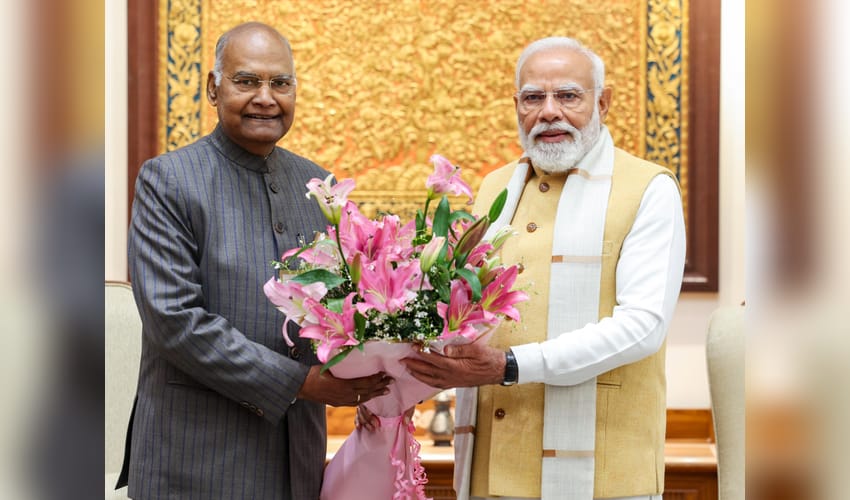

New Delhi, June 10 (AHN) Former President Ram Nath Kovind said that June 10 marks a special occasion in the history of post-Independence India, as on this date, Prime Minister Narendra Modi surpassed the first PM, Jawaharlal Nehru, to become the country's longest continuously serving democratically elected head of government.
"June 10, 2026, marks a special occasion in the history of India after Independence. On that date, Prime Minister (PM) Narendra Modi surpassed Jawaharlal Nehru to become the longest continuously serving democratically elected PM of India. Though a historic landmark in itself, PM Modi’s tenure being longer than that of Nehru does not capture the more important dimensions of what may be called the watershed period for India since Independence," Kovind said in a special article in the Hindustan Times.
The former President further said that since May 26, 2014, the course of Indian polity has taken a decisive turn towards the "Indian-ness" advocated by Mahatma Gandhi.
"Since May 26, 2014, the course of Indian polity has taken a decisive turn towards the Indian-ness of the kind advocated by Mahatma Gandhi, Sardar Patel, Babasaheb B.R. Ambedkar, Rajendra Prasad, C. Rajagopalachari, K.M. Munshi, and several other architects of modern India who had reimagined ancient Indian culture and civilisation with a deep sense of pride in its heritage and legacies. In the area of economic development, PM Modi has taken forward the model of Rajaji with inclusivity. Rajaji, as we know, was strongly critical of the 'command and control' model of Nehruvian political economy, which resulted in the 'quota, permit and licence raj'," he wrote.
He further said that PM Modi has been asserting on global forums that India is the mother of democracy.
"In the sphere of political discourse, despite the historic and scholarly statement by Ambedkar in his concluding address in the Constituent Assembly on November 25, 1949, that elements of parliamentary democracy were to be found in Buddhist institutions dating back 2,500 years and that those Buddhist institutions would have adopted democratic practices from the then-prevailing political institutions, our students and jurists were made to believe that we owed our democracy to Western countries. Modi has been asserting on global forums that India is the mother of democracy, referring to the ancient Indian democratic ethos and practices. And the world is waking up to this fact of India being not only the most ancient but also the largest and most vibrant democracy," Kovind stressed.
"The sheer size of India’s electorate, at nearly 100 crore, is a mind-boggling phenomenon for the rest of the world. Incidentally, the size of the electorate is nearly three times the total population of India at the time of Independence. Added to the size is the growing complexity of electoral dynamics. As many as 744 political parties participated in the 2024 general election, compared to only 53 in the 1951-52 general election," he said.
Kovind further said that PM Modi stands as an exception to the global trend.
"Aspirations of, and scrutiny by, the people have gone up exponentially compared to Nehru’s times. To measure up to such rising expectations and sustain a robust bond of trust with the people is an exceptional success of Modi, whose approval ratings have remained consistently high, compared with Nehru, who had to witness severe erosion in his stature and popularity during his tenure. During the decades of the 1950s and 1960s, and even up to the 1970s, many democratically elected leaders across the world had long tenures at the helm. The world of the 21st century has witnessed a much shorter shelf-life of political leaders. Modi stands as an exception to the global trend," he added.
He said that it is "rightly said that no people can become strong and respectable if they lack self-pride".
"...India has been a great story of civilisational and cultural excellence through many centuries. However, the sense of inferiority instilled by colonial rulers continued to cast its long shadow even after Independence. The continuation, and even glorification, of several colonial practices continued after Independence, and an elitist minority was created which perpetuated the ideas and ideals of Thomas Babington Macaulay. English was promoted as the language of power during the decades after Independence," Kovind said.
Kovind claimed that "the Nehruvian period and its immediate aftermath witnessed a sense of embarrassment among the elite about most things Indian".
"People speaking, working, or expressing themselves in Indian languages were looked down upon as inferior cousins. Cultural practices and symbols rooted in ancient Indian traditions were ignored in favour of ideologies and practices nurtured in alien soils. The lack of organic continuity and growth of Indian traditions had resulted in a lack of confidence and innovativeness," he said.
"Modi has front-staged Indian languages, systems, symbols, and belief systems. There is a visible pride among the people in being Indian and expressing Indian-ness. This new sense of pride was shared with me by many people from among the Indian diaspora during my visits to several countries. Modi chose a function organised by a leading English-language national daily to articulate the need to achieve the goal of mental decolonisation by 2035. At that function, held in November 2025, he urged the people of India to undertake a 10-year national pledge to shed the colonial mindset rooted in Macaulay’s legacy. He also made a very emphatic statement that India isn’t just an emerging market; it is emerging as a confident new model," Kovind added.
He also said that the "contrast between India’s initial decades after Independence and the last 12 years is highlighted by a major shift".
"... The Nehru years were marked by a keenness to seek approval and succour from the West, culturally and economically. The Modi years are marked by confidence in a robust domestic economy that is able to withstand the most severe global disruptions. The Modi years are also characterised by a strong sense of pride in Indian languages, cultural symbols, values, and traditions," he said.
"A young but very well-informed boy who happens to be related to us made a statement indicative of his precocity and also of the thinking of his generation. He told me that while I grew up in Nehru’s India, he is growing up in Modi’s Bharat. The boy also explained to me that his generation is better off for it," he added.



