



Politics
'Our law-and-order system is still colonial': Kiran Bedi (AHN Interview)
Published On Wed, 29 Jul 2026
Asian Horizan Network
3 Views
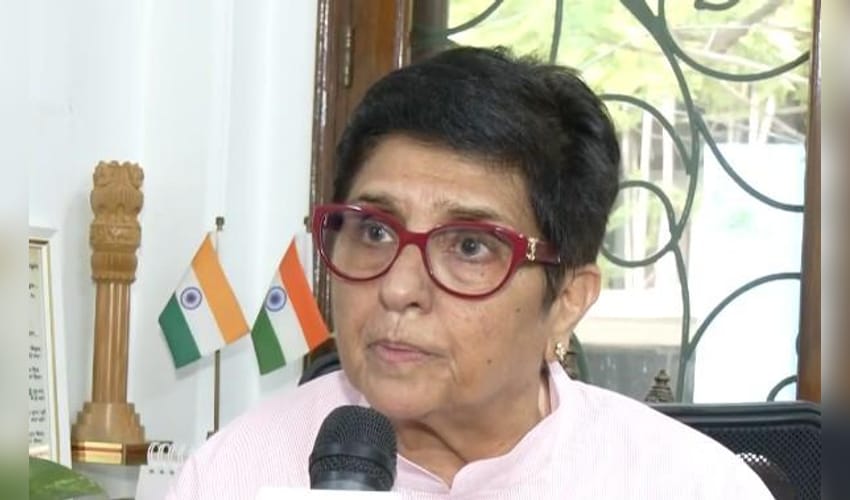

New Delhi, July 29 (AHN) Former IPS officer Kiran Bedi on Wednesday stated that the country's law-and-order system "is still rooted in colonialism", citing the alleged police brutality during the Cockroach Janta Party (CJP)-led agitation against exam irregularities.
Speaking exclusively to AHN, Bedi, also the former Lt Governor of Puducherry, said that Ramlila Maidan, instead of Jantar Mantar, should be declared as the official site to hold protests in the national capital in order to avoid similar conflicts in the future.
Excerpts from the interview:
AHN: You were a part of the Anna Hazare-led Lokpal agitation at the Ramlila Maidan; what difference did you see in the Cockroach Janta Party (CJP) led protests?
Kiran Bedi: Their venue was wrong. Their venue too should have been Ramlila ground. If (the protest) is brought to Parliament Street itself, then why would they not march to the Parliament?
So, we should now declare the Ramlila ground as the venue for all demonstrations where there is ample space and also necessary facilities, including toilets, food, and other support.
We must also remember that Ramlila Maidan was not the first choice for protests. When I began my service, demonstrations were allowed right outside the Prime Minister's residence, up to Teen Murti Marg. I witnessed this myself as a student.
Over time, the protest venue was gradually shifted to Tughlaq Road, then further back, then to India Gate. Later, protests were removed from Rajpath and shifted to Jantar Mantar. This venue is wrong and will always create problems.
It is small and narrow and also closer to the business district, Connaught Place...that is why all markets have to be closed when such demonstrations take place. Whenever an assembly is declared unlawful, and people protest against that, force will go because unlawful means 'tear gas', 'dispersal' and 'lathi charge'. So, that is why I think that the venue itself is wrong. We should rethink.
AHN: What are your views on handling of the Gen Z agitation?
Kiran Bedi: Our law and order system is still colonial; the use of lathi charge and directly using riot force. Why should riot force be used as the first resort? It should be the last. The first resort should have been civil defence.
They are young men and women who are trained and enrolled in every state; then why are they not being utilised? The first counter should be civil defence, which will mean students are handling students. No lathis; they should have body gear so that they can protect themselves.
Further, there should be women police at the second level after civil defence personnel.
If the demonstration had taken place from Ramlila Maidan, and it was countered with civil defence and then women police, if then too agitators didn't listen, then riot police could be the last resort as it could then have been justified.
AHN: What was the approach of the police force during the 2011 agitation? Did the police resort to lathi charge then too, under the UPA regime?
Kiran Bedi: I do not recall any situation where there was a lathi charge. I don't remember such an incident. Sections 144 and 188 (were imposed), and we offered peaceful arrests.
At Ramlila Maidan, we had ample space. Even at Jantar Mantar, if the protesters (in 2011) were on a hunger strike, it was peaceful. It was a peaceful protest, not a march.
AHN: What was the attitude of the then UPA government towards the protest?
Kiran Bedi: If its (UPA government's) approach had been more proactive, the situation could have been prevented. If the Lokpal Bill had been introduced earlier, the movement would not have escalated to such an extent.
There was no need to put Anna (Hazare) through so much hardship because what was accepted later could have been accepted much earlier. We made every possible effort by meeting different ministers and were repeatedly given assurances by them. The draft which was made later could have been made much earlier.
AHN: Prime Minister Narendra Modi has assured justice in paper leak cases. Do you have faith in the government's intentions and assurances?
Kiran Bedi: If we don't trust the government, then whom should we trust? They are the final authority, and they are taking action. They constituted the task force immediately and appointed highly capable people to it. However, the question is that it should not remain limited to testing alone; it should lead to broader educational reforms. That should be the expansion.
AHN: Was seeking former Union Education Minister Dharmendra Pradhan's resignation justified?
Kiran Bedi: The situation was brought to an extent which should not have been. I was told that he (Pradhan) himself had offered to resign when the issue had escalated. If that resignation had been accepted at the time, the situation could have been resolved then itself. It should not have been turned into an ego issue. Had that happened, this situation could have been avoided.
The issue had already affected all those students who wanted to appear for NEET or other competitive exams, and the damage was visible.
AHN: Following the CJP, several such pressure groups are now being formed online. What are your views on this?
Kiran Bedi: People have their own feelings, needs, demands, interests, planning and vision. They cannot be stopped (from expressing). You (government) will only have to respond; you have to be responsive to their demands, and what and why they are demanding.
It (government) should not think of it as criticism and instead deal with it. So, I think that the governance should be responsive and see the views that are being put across on social media. It should look into which views are destructive and which are constructive. Constructive opinions should be taken into consideration by the government and dealt with, and it should also respond to the destructive views.



