



Economy
Nvidia eyes $1 trillion revenue by 2027 as physical AI arrives: CEO Jensen Huang
Published On Tue, 17 Mar 2026
Asian Horizan Network
1 Views
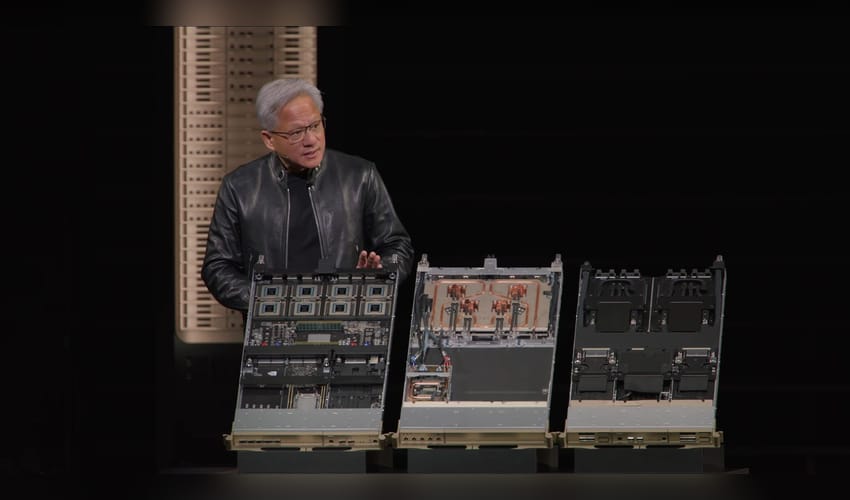

New Delhi, March 17 (AHN) Major chipmaker Nvidia made a series of announcements at its annual GTC event, with CEO Jensen Huang saying that the company could generate up to $1 trillion in revenue from AI chips alone by 2027 amid the ongoing rapid growth in artificial intelligence industry.
Speaking at the event held in San Jose, California, Huang outlined Nvidia’s strategy to dominate the AI ecosystem by building an integrated stack of hardware, software and infrastructure.
One of the key highlights of the keynote was Huang’s projection that cumulative demand for Nvidia’s next-generation AI platforms, including Blackwell and Vera Rubin systems, could translate into $1 trillion in revenue by 2027.
"I believe that computing demand has increased by 1 million times in the last two years," Huang said, underscoring the surge in AI-driven workloads across industries.
Among product announcements, Nvidia introduced the Groq 3 Language Processing Unit (LPU), designed to accelerate AI inference workloads.
The chip -- expected to ship in the third quarter -- is built on Nvidia’s GPU-based architecture with optimisations for higher speed and efficiency.
The company also unveiled its next-generation computing system, Vera Rubin Space One, which is being developed in collaboration with partners for deployment in space-based data centres. A satellite launch tied to the project is expected later this year.
“Physical AI has arrived — every industrial company will become a robotics company,” said Huang. "NVIDIA’s full-stack platform — spanning computing, open models and software frameworks — is the foundation for the robotics industry, uniting a worldwide ecosystem to build the intelligent machines that will power the next generation of factories, logistics, transportation and infrastructure," he added.
In another major reveal, Nvidia showcased a prototype of its upcoming rack-scale architecture, Kyber, which will succeed the Rubin platform. The system is designed to integrate up to 144 GPUs in vertically stacked configurations to improve compute density and reduce latency. The architecture is expected to be part of the Vera Rubin Ultra system, likely to ship in 2027.
On the automotive front, Huang said Uber is planning to roll out a fleet powered by Nvidia’s Drive AV software by 2028 across multiple global cities, starting with Los Angeles and San Francisco next year.
The Nvidia CEO also said that automakers including Nissan, BYD, Geely, Isuzu and Hyundai are working on Level 4 autonomous vehicles using Nvidia’s Drive Hyperion platform.
Nvidia has been rapidly accelerating its innovation cycle in recent years, aiming to refresh its core product lineup annually while expanding into new AI-driven computing segments.



