



World
Kuwait airport attack result of malfunctioned US defence systems: Iran envoy (AHN interview)
Published On Fri, 05 Jun 2026
Asian Horizan Network
2 Views
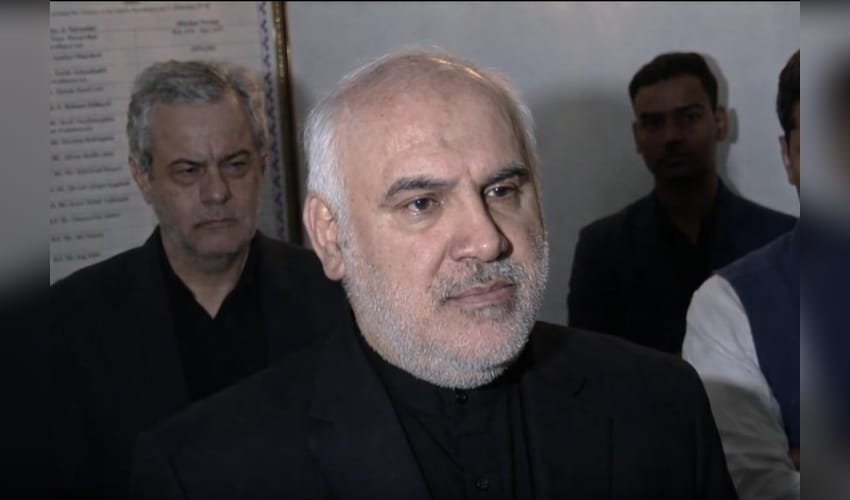

New Delhi, June 5 (AHN) Assessments and investigations conducted by Tehran's military experts indicate that no Iranian missiles were launched toward Kuwait airport, Mohammad Fathali, Ambassador of Iran to India, told AHN in an exclusive interview on Friday.
An Indian national was killed and dozens of other people injured during Wednesday's attack on Kuwait International Airport.
"The damage to the airport appears to have resulted from a malfunction of US-made Patriot defence systems, whose interceptor missiles fell onto the terminal after failing to intercept Iranian missiles targeted elsewhere," said the Iranian Ambassador.
He, however, made it clear that Iran will continue to defend its territorial integrity and sovereignty and will "utilise all capabilities" to counter aggressive actions.
Excerpts:
AHN: Recent reports suggest that tensions between the United States and Iran have escalated again despite ongoing diplomatic efforts. How does Iran assess the current situation, and is a diplomatic breakthrough still possible?
Ambassador Mohd Fathali: We have previously declared that we are prepared for both war and peace. We welcome dialogue and negotiation, and we firmly believe that disputes and differences can be resolved through diplomacy. The Islamic Republic of Iran has never initiated war or tension and has consistently emphasised political and peaceful solutions. Regrettably, however, the ceasefire that was announced on April 8 has been repeatedly violated by US forces in recent days. Consequently, Iranian military forces have responded to these attacks within the framework of their legitimate right to self-defence. While we remain committed to the ceasefire and have chosen the path of dialogue, Iran's national security and sovereignty remain our red line. Any attack or aggression against our country's territory will be met with a reciprocal response at the same level, and if necessary, with greater severity. At the same time, we believe there is still an opportunity for diplomacy and reaching an understanding, provided that the opposing party also abides by its commitments and refrains from escalatory actions and ceasefire violations.
AHN: How do you view the recent US House resolution aimed at restricting President Trump’s authority in the Iran conflict? Does it signal political division within Washington?
Ambassador Mohd Fathali: Whether the passage of such a resolution indicates internal disagreement or political division within the United States is a matter that should be directed to American politicians and analysts. We do not comment on the internal affairs of the United States. What matters to us is that any action contributing to the reduction of tensions, the prevention of an escalation of conflict, and the preservation of regional peace and stability is a positive and noteworthy step. From this perspective, we view this measure as a step toward preventing the spread of tensions and avoiding the resumption of war.
Iran has never sought, nor does it seek, war. We have consistently emphasized that existing disputes must be resolved through dialogue, mutual respect, and adherence to international commitments, rather than through threats and the resort to force. It is natural that different perspectives on foreign policy issues exist in any country, including the United States. What is crucial is that voices advocating for diplomacy, restraint, and the peaceful resolution of disputes play a more effective role in preventing crisis. We continue to believe that the solution to current issues is not to be found on the battlefield, but rather at the negotiating table and through constructive dialogue.
AHN: How does Iran respond to allegations that it carried out an attack on Kuwait International Airport, which reportedly resulted in civilian casualties, including foreign nationals such as an Indian citizen?
Ambassador Mohd Fathali: The actions being taken by Kuwait and Bahrain constitute a flagrant violation of the fundamental rules of international law and the principle of good neighborliness, and in accordance with United Nations General Assembly Resolution 3314, are considered acts of aggression against Iran. Under this resolution, allowing aggressor parties to use their land, sea, and airspace, or the facilities and bases located within their territories, to launch or support military aggression against Iran qualifies as committing an act of aggression against our country.
In exercising our inherent right to defend our territorial integrity and national sovereignty, we will utilize all capabilities to counter aggressive actions, including targeting the origin and source of such attacks. Although the assessments and investigations conducted by our military experts indicate that no Iranian missiles were launched toward Kuwait Airport, the damage to the airport appears to have resulted from a malfunction of US-made Patriot defence systems, whose interceptor missiles fell onto the terminal after failing to intercept Iranian missiles targeted elsewhere. Furthermore, any Iranian drone launches targeting US military objectives in Kuwait, as well as any resulting impacts, occurred around midnight and under conditions of darkness. However, the photos and videos circulated in support of these allegations clearly show broad daylight, indicating that the footage was recorded during the daytime. This discrepancy demonstrates that the videos in question are fabricated and do not correspond to the events being claimed. We do not seek to kill civilians, but the responsibility for the consequences and repercussions arising from this situation undoubtedly rests with the US–Zionist aggressors and all parties that cooperate with them by placing their territory and facilities at their disposal.
AHN: What is Iran’s view on the impact of the Israel–Lebanon conflict on Lebanon’s sovereignty and internal stability?
Ambassador Mohd Fathali: We have consistently emphasised the necessity of respecting Lebanon's sovereignty, territorial integrity, and independence. We believe that Lebanon's security must be ensured by the Lebanese people and government, and no country has the right to impose its will on another nation through the use of force. We have also stressed that ending the war against Lebanon must be an integral part of any agreement to establish peace in the region. We oppose the killing of civilians and innocent people, regardless of their nationality or religion, and believe that the only way to achieve lasting peace is to put an end to the crimes of the Israeli regime.
AHN: At a time of heightened global uncertainty, what message does Iran want to send to the United States and the international community about peace and stability?
Ambassador Mohd Fathali: Iran is a country with a civilization spanning over seven thousand years, which throughout history has always been a messenger of peace, coexistence, and friendship among nations. Our historical identity and culture are built upon constructive dialogue and cooperation with other nations. Historical reality demonstrates that Iran has not initiated any war in more than three centuries and has always supported peaceful mechanisms for dispute resolution. The logic of the Islamic Republic of Iran is the logic of dialogue, diplomacy, and engagement based on mutual respect. In the current environment, where the world faces increasing challenges and uncertainties, Iran’s message to the United States and the international community is clear: sustainable peace, stability, and security can only be achieved through respect for the rights of nations, adherence to the principles of international law, and equal, constructive dialogue. We hope that the United States will accept the reality of a powerful, independent Iran that holds an important regional and international standing, and that it will recognize the legitimate rights of the Iranian nation. Iran has always been ready for engagement and cooperation based on mutual respect and shared interests, and believes that a more secure and stable future for all nations is achievable through diplomacy and mutual understanding.



