



Lifestyle
Jal Shakti Ministry expands ODF net in rural India during 2025
Published On Thu, 01 Jan 2026
Asian Horizan Network
0 Views
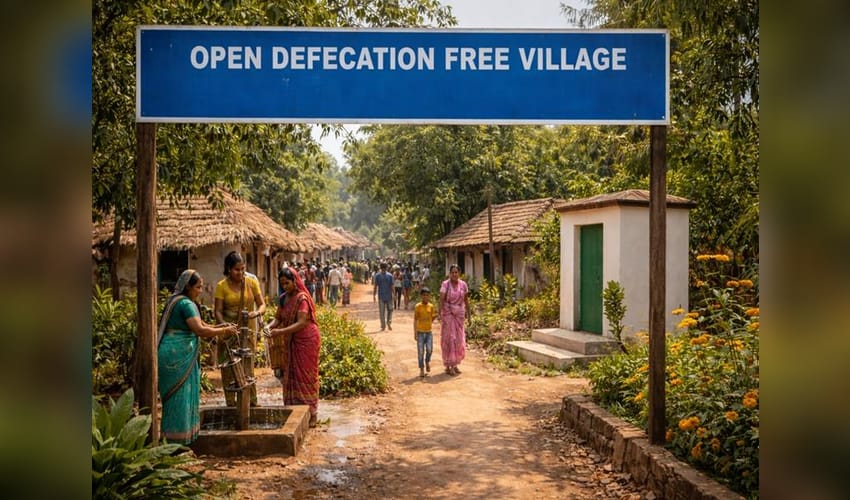

New Delhi, Jan 1 (AHN) The Jal Shakti Ministry made significant strides in 2025 under the Swachh Bharat Mission (Grameen) Phase II, with over 83 per cent of villages declared as ODF Plus (Model), more than 5.27 lakh villages having arrangements for solid waste management and 5.41 lakh villages having arrangements for liquid waste management, an official said on Thursday.
The Swachhata Hi Seva (SHS) 2025 campaign, conducted during September and October, witnessed mass participation and Jan Bhagidari from over 18 crore people, including more than 13 crore individuals from rural India.
Inspired by Prime Minister Narendra Modi’s nationwide call, Union Minister for Jal Shakti C.R. Patil led a Shramdaan programme at Kalindi Kunj under Swachhata Hi Seva 2025 as part of the ‘Ek Din, Ek Ghanta, Ek Saath’ initiative.
The Minister of State for Jal Shakti also engaged in a dialogue with more than 150 sarpanches ahead of the 79th Independence Day celebrations in 2025.
According to the official, the Department of Drinking Water and Sanitation’s (DDWS) ‘Hamara Shauchalay, Hamara Bhavishya’ campaign led to the repair and beautification of over one lakh Individual Household Latrines (IHHLs) and more than 550 Community Sanitary Complexes (CSCs).
The campaign also recorded over 49,000 information, education and communication (IEC) and behaviour change communication (BCC) events, which saw participation from more than 32 lakh individuals, the official said.
Sharing details on the Swachh Bharat Mission (Grameen), the official said it is a centrally sponsored scheme launched by Prime Minister Narendra Modi on October 2, 2014.
“The mission aimed to make India Open Defecation Free (ODF) by October 2, 2019, the 150th birth anniversary of Mahatma Gandhi. The focus of SBM(G) Phase I was to provide access to toilets for all rural households across the country,” the official said in a statement.
As a result, by October 2019, all villages nationwide had declared themselves ODF, with rural sanitation coverage increasing from 39 per cent in 2014 to 100 per cent in 2019.
SBM(G) Phase II was launched in 2020 after India was declared ODF, with the objective of achieving Sampoorna Swachhata and ensuring that no one is left behind in gaining access to individual household toilets and proper waste management systems, while progressing towards ODF Plus (Model) village status.
The key objective of SBM(G) Phase II is to ensure that all villages sustain their ODF status and move towards becoming ODF Plus (Model) villages. The programme focuses on ODF sustainability, solid waste management, liquid waste management and visual cleanliness.
In 2025, the total programme outlay for SBM(G) Phase II stood at over Rs 1.40 lakh crore. As per the SBM(G) IMIS portal as of December 16, 2025, more than 12 crore Individual Household Latrines and 2.67 lakh Community Sanitary Complexes have been constructed since October 2, 2014.
Over 4.89 lakh villages have been declared ODF Plus (Model), of which more than 4.15 lakh villages have been verified as ODF Plus (Model). More than 5.27 lakh villages have arrangements for solid waste management, over 5,300 blocks have arrangements for plastic waste management, and more than 5.41 lakh villages have arrangements for liquid waste management, the statement said.
Under the GOBARdhan initiative, more than 970 community biogas plants are currently functional. As many as 21,306 training programmes have been conducted, covering 1,15,274 gram panchayats, the official added.



