



Asia In News
Jagan accuses Naidu govt of weakening education in Andhra government schools
Published On Sun, 23 Aug 2026
Asian Horizan Network
4 Views
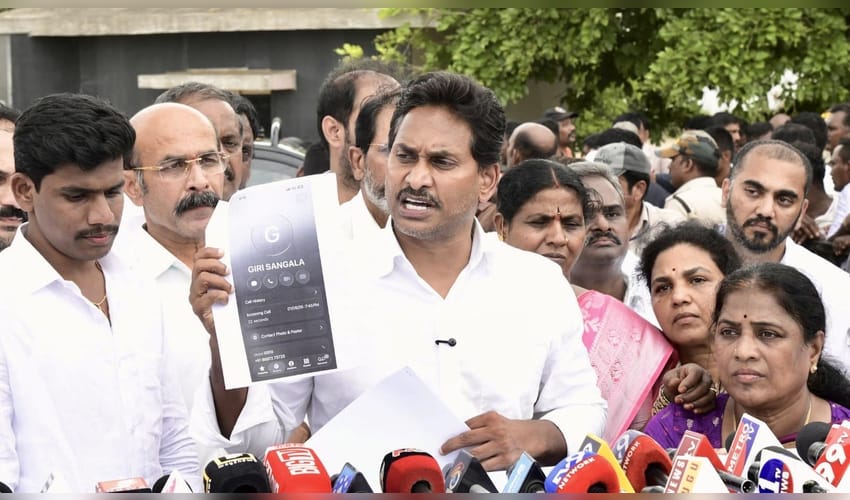

Amaravati, Aug 23 (AHN) Disputing the claims of the coalition government in Andhra Pradesh of an increase in enrolment in government schools in the state, former Chief Minister and YSR Congress Party president Y.S. Jagan Mohan Reddy on Sunday accused it of weakening education in the government sector to support the growth of private institutions.
Citing data from the Unified District Information System for Education Plus (UDISE +) for the academic year 2025-26, he said this brought to light a very dangerous trend in the State of Andhra Pradesh.
“There is a clear reduction in the number of enrolments during AY 2025-26, when compared with AY 2023-24, the last year of our government, particularly in government schools. The state government has repeatedly claimed that over 1.10 lakh students have shifted from private schools to government schools, portraying it as evidence of growing public confidence in government education. This is in line with their party's philosophy of making most unjustifiable claims and ones which are very clearly exposed and contradicted by official statistics and figures,” YS Jagan said in a social media post.
“If government schools were indeed witnessing such a large influx of students, the overall enrolment in government schools should have increased. Instead, the UDISE plus (Unified District Information system for School Education, Ministry of Education, Government of India) comparison between AY 2023-24 and AY 2025-26 shows that government school enrolment fell from 40,50,116 to 34,93,450 students, a decline of 5,56,666 students. At the same time, the number of government schools have also been reduced from 45,000 to 44,222, while government-aided schools declined from 991 to 797. What is also noteworthy is that during the same period, the enrolment of students in schools operating under private management have increased from 45,53,380 in 2023-24 to 48,40,296 in 2025-26,” he said.
“Therefore, the enrolment in Government and Government aided schools has come down and the enrolment in private schools has increased. This clearly demonstrates the plight of Government schools in AP and proves that the claim of the State Government is incorrect,” the former Chief Minister said.
He claimed that the Andhra Pradesh private education sector is dominated by institutions such as Narayana, Sri Chaitanya, Bhashyam, Vignan, and GITAM. He alleged that the Chandrababu Naidu government has a close unholy association with these institutions and is therefore clearly weakening education in the government sector to support the growth of private sector educational institutions.
The statistics indicate a very worrisome trend of quality education being made inaccessible to students who are unable to afford to enrol in private schools, he added.
He claimed that during the period of the YSRCP regime between 2019-24, the number of reforms and transformative steps initiated brought about substantial improvements in the education system.
According to him, the emphasis of the YSRCP government was on making quality education accessible to everyone.
The Mana Badi - Nadu Nedu initiative had modernised the infrastructure across 56,703 government schools, welfare hostels, and junior colleges by upgrading facilities like furniture, drinking water, sanitation, classrooms and so forth. Phase I, covering 15,715 schools, was completed, while Phase II extended these improvements to 22,344 schools and Phase III was underway by June 2024, he said.
He pointed out that free Tabs with pre-loaded BYJU's content were provided to Class 8 students and their teachers. English medium was made the medium of instruction from the primary level, and to make the transition seamless, bilingual textbooks and an Oxford dictionary were made available to all students. This is most pertinent, considering the reality that our children must be capable of competing in the global arena.
Further, 62,000 IFPs were installed in every classroom from Class 6 and above to boost digital education; 45,000 smart TVs were installed in every school having Classes from 1st to 5th.
With respect to TOEFL, a subject was introduced from Class 3 onwards to help students develop spoken English skills. An MOU to this effect was signed with American Educational Testing Services (ETS) to provide international certification for TOEFL.
Further, a major reform was initiated to enable students to compete and succeed at the global level. IB (International Baccalaureate) was planned to be introduced, and work in this regard had commenced with capacity building and providing training in the IB system to teachers, school heads, MEOs and other faculty, YS Jagan added.



