



World
India's balanced approach to Myanmar gains strategic importance
Published On Sat, 20 Jun 2026
Asian Horizan Network
3 Views
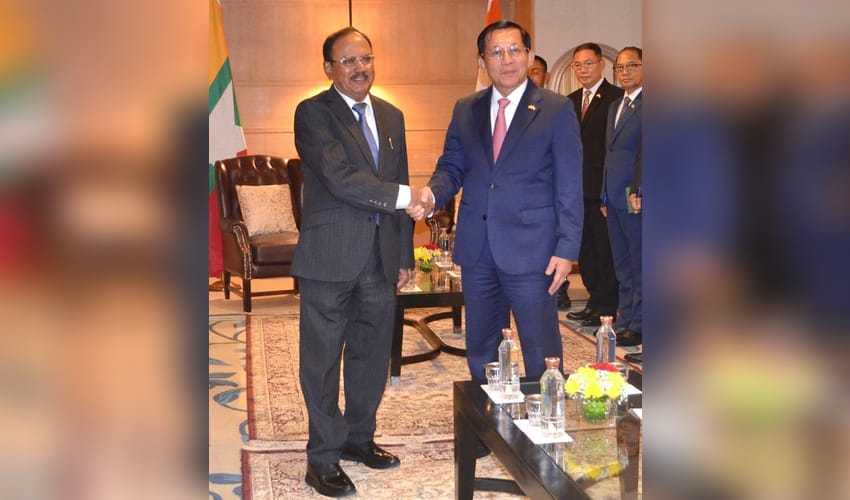

Athens, June 20 (AHN) The recent visit of Myanmar’s President U Min Aung Hlaing to India carried significance beyond diplomatic protocol. It reflected Myanmar's search for a balancing strategy, gave India an opportunity to engage with a volatile neighbour whose instability directly impacts the Northeast, and served as a reminder for China that influence does not necessarily translate into trust.
“India does not offer Myanmar the same scale of money, infrastructure, or coercive leverage that China does. But India offers something China cannot easily provide: A relationship less burdened by domination,” a report in the 'Greek City Times' stated.
According to the report, unlike China, India has not been deeply involved with armed border actors in Myanmar; instead New Delhi draws religious and spiritual links — reflected in President Aung Hlaing's visit to Bodh Gaya, which he has undertaken during his previous visits as well.
The report noted that India has no interest in pursuing indirect influence through ethnic groups but is rather focused on a stable, sovereign Myanmar given that instability in the Southeast Asian nation directly affects India’s Northeast.
India and Myanmar share a 1,643-km land border across Arunachal Pradesh, Nagaland, Manipur, and Mizoram, with communities on both sides linked by kinship, clan, tribal, linguistic, and religious ties.
“Instability in Chin, Sagaing, Kachin, or Rakhine (states bordering or in the immediate vicinity of India) does not remain confined to Myanmar. It spills into Mizoram, Manipur, and Nagaland through refugee flows, arms trafficking, narcotics, insurgent movements, and social tensions. India is said to have carried out a few drone-based attacks in Myanmar territory against Indian insurgent groups. It shows the importance of having the Myanmar military on board,” the report detailed.
“For India, Myanmar is, therefore, not an optional diplomatic theatre. It is central to internal security. The violence in Manipur since 2023, refugee inflows into Mizoram, the presence of Indian insurgent groups in Myanmar’s borderlands, and the flow of weapons and narcotics from the Golden Triangle all show that Myanmar’s instability becomes India’s security challenge. A fractured Myanmar weakens India’s Act East policy. A stable Myanmar strengthens India’s Northeast,” it added.
Highlighting Myanmar’s strategic value in terms of connectivity, the report estimated that India has already invested over Rs 1,000 crore on its two flagship projects — the Kaladan Multi-Modal Transit Transport Project and the India-Myanmar-Thailand Trilateral Highway.
“Both have suffered because of Myanmar’s security situation. These projects are not merely economic. They are instruments of strategic transformation. When completed and secured, they can reduce the Northeast’s landlocked nature, expand trade, provide alternatives to the Siliguri Corridor, and link India more directly with Southeast Asia,” it noted.
Emphasising the positive aspect of the India-Myanmar engagement, the report said, “A peaceful Myanmar is essential for a peaceful Northeast. A sovereign Myanmar is in India’s interest. And a Myanmar with options beyond China is good not only for New Delhi but also for Naypyidaw and the world.”



