



World
India now an 'indispensable anchor': Vinay Kwatra
Published On Tue, 30 Jun 2026
Asian Horizan Network
5 Views
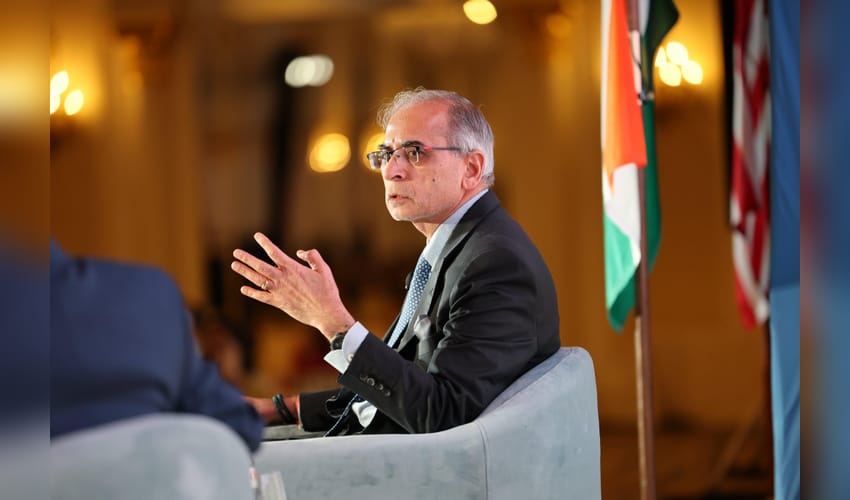

Washington, June 30 (AHN) India has evolved from being merely an important global partner to becoming an "indispensable anchor" of the international order, driven by sustained economic growth, trusted partnerships and technological transformation, India's Ambassador to the United States Vinay Mohan Kwatra said.
Speaking at the US-India Strategic Partnership Forum (USISPF) Leadership Summit, Kwatra said India's economic rise under Prime Minister Narendra Modi had positioned the country to play a stabilising role amid geopolitical uncertainty, while strengthening cooperation with partners such as the United States across trade, technology and strategic sectors.
"I would frame your phraseology slightly differently. I would say given the kind of challenges and disruptions that we face, Prime Minister Modi's India is not just an indispensable bridge. I think it's an indispensable anchor of the global order, of the economic growth, of stability, of trust and reliability," Kwatra said.
He said India's growing global role was underpinned by three factors: a rapidly transforming domestic economy, an increasingly uncertain geopolitical landscape, and structural reforms that had strengthened the country's economic resilience.
Kwatra said India's policy framework since 2014 had centred on long-term economic transformation while preserving macroeconomic stability.
"What that has meant domestically for us in India under the leadership of Prime Minister since 2014, has been a series of economically transformative measures on the ground, which have resulted in our consistently high growth of seven plus per cent, which is uniquely driven by domestic demand," he said.
He said the government's vision of Atmanirbhar Bharat was not inward-looking but designed to create globally competitive manufacturing and resilient supply chains.
"Prime Minister has propounded... a mixture of self-reliance and self-sufficiency, but an ecosystem which has positive externalities, which is not insular in nature."
He also highlighted India's emphasis on manufacturing, advanced technologies and multiple dimensions of economic security.
"I would say food security, energy security, health security. You could end up these three and many other securities in the larger frame of economic security," he said.
Kwatra projected that India, currently a $4.3 trillion economy, was on course to reach about $7 trillion by the end of the decade, around $14 trillion by the middle of the 2030s and between $25 trillion and $30 trillion by 2047.
The ambassador said emerging technologies would define the next phase of India-US cooperation, identifying biotechnology, artificial intelligence and semiconductors as priority sectors.
Referring to the recently launched BioSaarthi 2026 initiative, he said India was preparing for a new wave of innovation in biotechnology and biopharmaceuticals.
"This is an area where India already is blessed with a very strong base of universal talent," Kwatra said, adding that the initiative sought to strengthen innovation, manufacturing, regulation and drug discovery.
He said biotechnology had become a central pillar of the bilateral TRUST initiative launched during Prime Minister Modi's visit to the United States.
"We see this as a space which would have essentially four legs to cooperation in biotechnology — one manufacturing... two trade... three research and innovation... and four regulatory cooperation."
Kwatra also highlighted India's expanding biotechnology startup ecosystem.
"In India as of yesterday, we have roughly 12,000 startups in the biotechnology sector."
He said connecting those startups with the US venture capital ecosystem would significantly strengthen innovation between the two countries.
On artificial intelligence, Kwatra said India was working across the entire AI value chain.
"So far as India is concerned, we are working across all five layers."
He stressed that AI should ultimately be judged by the outcomes it produced rather than the technology itself.
"If the AI has to scale up into a form which is acceptable to the society, eventually it needs to transform itself into the kind of outcomes that the people can relate to."
He added that India sought "a degree of strategic autonomy and resilience" across all layers of AI while partnering closely with the United States.
Kwatra said achieving the bilateral goal of $500 billion in trade by 2030 would require much deeper integration than simply increasing exports and imports.
"One of the important markers that the two leaders defined... is Mission 500, which is to achieve a bilateral trade of $500 billion by the end of 2030."
"We are currently at about 240 billion."
He said trade growth would depend on stronger supply chains, greater investment, manufacturing collaboration, innovation and mobility of skilled talent.
"Trade doesn't move in isolation."
"Trade moves when your supply chains are better connected... when there is a strong flow of capital... when the innovation, investment, manufacturing and skill mobility converges together."
Citing semiconductors as an example, Kwatra said India had moved from having virtually no semiconductor manufacturing ecosystem to commissioning Micron's facility and preparing for commercial production.
"Two, three years ago, we had a nascent to negligible semiconductor industry."
"Pilot production hopefully should commence... by the end of this year and commercial production by the end of next year."
He described the progress as "a very concrete journey" of India-US industrial partnership.
Looking ahead, Kwatra said trust, reliability and secure supply chains would define the future of India-US cooperation.
Asked what message he would leave with participants at the summit, he replied: "Trust, reliability, supply chain, security, and benefit people of the two countries and economic growth and prosperity."
He also said India looked forward to working closely with the United States at this year's G20 Summit, recalling that New Delhi had achieved consensus during its own presidency despite a challenging geopolitical environment.
India and the United States have steadily expanded cooperation in critical and emerging technologies, semiconductors, biotechnology, artificial intelligence, quantum computing and resilient supply chains over the past several years. These initiatives have become central pillars of the broader strategic partnership alongside defence, energy and trade.
The two countries are also pursuing an ambitious roadmap to raise bilateral trade to $500 billion by 2030 while strengthening collaboration under initiatives such as the TRUST framework and the India-US COMPACT, reflecting a shared emphasis on innovation, trusted technology ecosystems and long-term economic resilience.



