



Politics
FairPoint: From BJP's victory asana to Rahul's eternal discontent, Indian politics has its own Yoga
Published On Sun, 21 Jun 2026
Deepika Bhan
2 Views
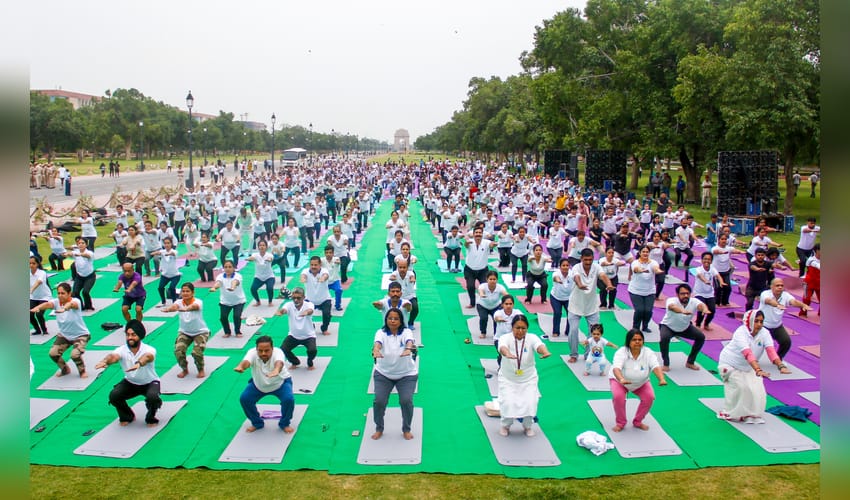

New Delhi, June 21 (AHN) The yoga mats have been rolled up and the photographs uploaded; however, after watching the annual event, one cannot help but question whether politicians truly require formal yoga training, as many appear to have been engaging in more advanced asanas for years.
In fact, politics increasingly resembles one giant yoga camp where every party has developed its own signature posture.
The ruling establishment, for example, has mastered what may be called the Victory Asana.
This is an advanced pose that requires practitioners to maintain the confidence of a champion athlete regardless of circumstances. Electoral victories have helped build a strong national presence, and people are generally happy. The true test of the posture is maintaining the same confidence after practising for more than a decade, which this dispensation is doing so repeatedly, at the Centre and in states.
The latest being West Bengal, where the most difficult battle was won with what can only be described as Precision Yoga -- a combination of several difficult asanas performed in perfect sequence.
The ruling party is usually careful about how it approaches these asanas. But occasional glitches do appear, as seen in the Karnataka MLC polls, where some members cross-voted.
The Opposition, meanwhile, specialises in a very different discipline: the Eternal Protest Pose.
The rules are simple. If the government moves left, oppose it, and if it moves right, oppose it. If it remains still, again oppose by labelling it as an inability to move. The objective is consistency through disagreement, and a few practitioners have adopted this posture with greater dedication than Rahul Gandhi.
He has become the chief practitioner of what may be the most demanding posture in contemporary politics: the Eternal Discontent Asana.
For years, he has practised dissatisfaction regardless of the political weather. If the government announces progress, the progress is questioned. If it backtracks, the reversal is criticised, and even if it stands still, stagnation becomes the subject of criticism.
The discipline is sustained across election cycles with remarkable consistency. In this form of yoga, contentment is not the goal -- continuity of critique is. The practitioner must also convince the country that he is the natural alternative to Prime Minister Narendra Modi, reassure Congress workers that victory is achievable, and assure alliance partners that he can be the leader, and Gandhi has been doing all this.
If Rahul Gandhi is committed to Eternal Discontent Asana, others in the Opposition are attempting similar postures -- with one key difference: they want national hand-holding while maintaining regional supremacy. Maintaining that balance, under such conditions, deserves professional recognition.
Akhilesh Yadav has perfected what may be called the Coalition Contortion Asana; rather, it is a kind of Alliance Stretch. Ideological muscles are extended far beyond their natural limits without quite tearing. Yesterday’s rival becomes today’s ally, and today’s ally becomes tomorrow’s negotiation. Yoga teaches flexibility, and coalition politics has worked on it.
Arvind Kejriwal once practised what might be called the Rapid Motion Asana. For years, he seemed to be everywhere at once -- campaigning, governing, protesting, debating, accusing, and defending. More recently, after electoral losses, he appears to have entered a more demanding discipline: Strategic Meditation. The challenge now is to remain politically relevant while speaking less than before. Anyone who has tried meditation knows how difficult it can be.
Mamata Banerjee, meanwhile, has become the unexpected face of the Defiant Reality Asana. The posture is a careful balance between acceptance and resistance -- held even when the ground beneath begins to shift.
For years, she appeared politically indestructible. Election after election, challenge after challenge, she convinced supporters that Bengal politics revolved around her. Then came 2026, and her government fell. The party suffered its biggest setback, and even she lost her seat.
Politics, much like yoga, has a habit of testing those who become too comfortable in a position. The challenge before her now is not defeating opponents, but rebuilding confidence among supporters who had forgotten what defeat looked like.
Her INDIA bloc colleague Uddhav Thackeray has become the undisputed master of the Shrinking Circle Asana. This is a posture in which practitioners continue to claim ownership of a tradition even as organisations, representatives, symbols and even flags gradually move elsewhere.
His political journey in recent years resembles a long workshop on regaining balance after repeated falls. His government collapsed, and the Shiv Sena split. The party symbol became a subject of legal and political dispute. And now even his parliamentary colleagues have chosen different paths. He, however, seems to be trapped in the Illusion Yoga posture, insisting he represents the authentic legacy.
Collectively, however, the Opposition’s greatest contribution to political yoga remains the INDIA bloc Pranayama. The exercise begins with a deep inhalation of unity, and the participants then hold their breath through seat-sharing negotiations. A long exhalation follows when disagreements emerge. The cycle repeats before every major election.
The ruling side has developed its own breathing exercise: inhale electoral victories, exhale confidence -- often in generous quantities. Occasionally, so much confidence is released that discussions begin about elections still years away.
The most remarkable thing about Indian politics, perhaps, is that everyone believes they are practising different philosophies while performing remarkably similar movements.
But in all this, voters quietly go about their lives. Every election season, they remind everyone who the real yoga masters are. They alone have the ability to make powerful leaders lose their balance through the Voter Asana.
It is only the voter who knows how to pull the rug from under the mat and topple a leader.
(Deepika Bhan can be contacted at [email protected])



