



Asia In News
'Every soldier must be capable of operating drones': Army chief says cadets being training for future battlefields
Published On Sat, 30 May 2026
Asian Horizan Network
1 Views
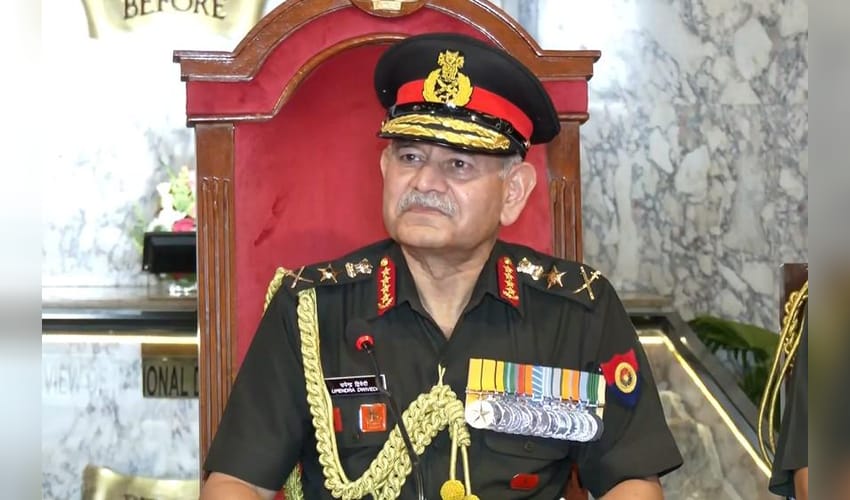

Pune, May 30 (AHN) Indian Army chief General Upendra Dwivedi on Saturday said that every soldier in the Indian armed forces should possess the capability to operate drones, stressing that extensive training and practical exposure to drone systems, simulators and counter-drone technologies are being provided to cadets and personnel to prepare them for future battlefields.
Replying to an AHN question during a press conference held after the Passing Out Parade (POP) of the 150th Course of the National Defence Academy (NDA) here, General Dwivedi highlighted the growing importance of drone warfare and said the army has taken several initiatives to ensure soldiers are equipped with the necessary skills to operate such systems.
Explaining his vision, he said that soon after assuming office, he had emphasised the concept of "Eagle on the Arm", a phrase symbolising the need for every soldier to be proficient in handling drones.
“After I took over as the army chief, I said 'Eagle on the arm'. This means that every soldier should have an eagle in his hand. When I say this, I am not referring to a bird; I am talking about drones. This means that every soldier should have the capability to operate a drone," he said.
General Dwivedi noted that training infrastructure related to drone operations is being steadily strengthened across military institutions and academies.
"You may have seen that in our academies and other places, training is being conducted and simulators are available. When I came here in December, I personally spoke to the Commandant and provided the Army Training Team with around four to six large drones and simulators. After that, the Commandant took significant steps, and many more drones have been brought here," he said.
The army chief underlined that modern warfare increasingly relies on drone technology and that soldiers must be familiar not only with operating drones but also with counter-drone systems designed to neutralise aerial threats.
"It is important for every soldier to have knowledge about drones and counter-drone equipment. This is because when a soldier goes onto the battlefield, drones will be used to such an extent that controlling and responding to them will require extensive knowledge. That is why we are providing training to every cadet using live drones and simulators," he added.
General Dwivedi also spoke about the progress being made towards theatreisation of the Indian armed forces, describing the initiative as being on the "right track".
Addressing questions on the proposed restructuring of military commands, he said discussions within the Chiefs of Staff Committee had been completed, and the recommendations had already been submitted to the government.
"As far as theatreisation is concerned, it is on the right track. As of now, all discussions on theatreisation have been completed within the Chiefs of Staff Committee. The complete report has been submitted to the Defence Minister. It is currently undergoing review by various stakeholders," he said.
The Army Chief further stated that the Chief of Defence Staff (CDS) and the three Service Chiefs had carefully examined the proposal to ensure that the interests and operational requirements of all three services were adequately addressed.
"In this regard, the CDS and the three Service Chiefs, including the outgoing CNS and CDS, have taken a conscious view to ensure that the major interests of all three services are met," he said.
Explaining the proposed command structure under theatreisation, General Dwivedi said integration and synergy among the services would require adjustments from all stakeholders, but would ultimately enhance operational effectiveness.
"Whenever you find that a certain level of synergy has to be brought in, there will be some kind of give-and-take by all three services. Therefore, the Service Chiefs will be responsible for raising, training, and sustaining functions, while the theatre commanders will be responsible for operations and orchestration of forces," he said.
Expressing optimism about the future of the reform process, the army chief said the next phase under the new CDS would help advance the initiative further.



