



Asia In News
Congress confident of decisive UDF victory in Kerala amid strong anti-incumbency: Shashi Tharoor (AHN Interview)
Published On Tue, 07 Apr 2026
Asian Horizan Network
1 Views
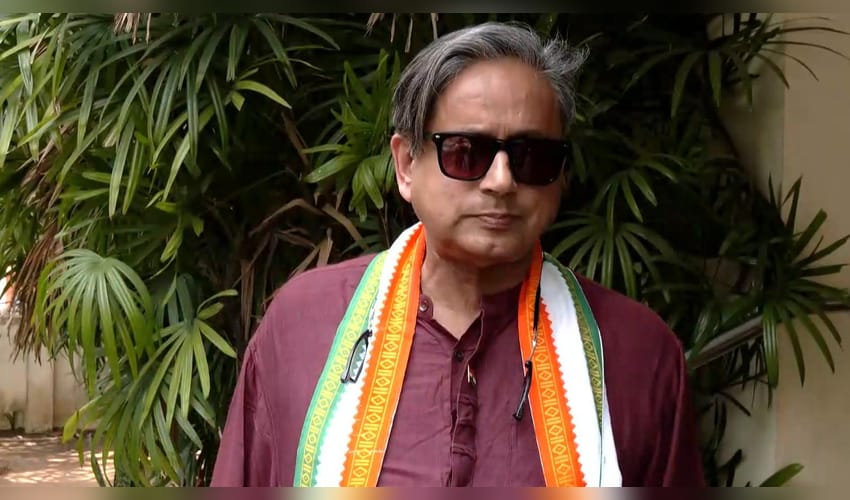

Thiruvananthapuram, April 7 (AHN) Senior Congress leader Shashi Tharoor expressed strong confidence in the United Democratic Front’s (UDF) prospects in the Kerala elections, projecting a clear victory for the alliance while downplaying the Bharatiya Janata Party’s (BJP) impact in the state.
In an extensive interaction with AHN, he also shared his views on Prime Minister Narendra Modi’s campaign, governance issues, key national policy debates, and India’s diplomatic approach to global conflicts.
Here is the text of the interview:
AHN: What is your opinion on the Kerala elections? Is it a cakewalk for Congress, or is the fight tough?
Shashi Tharoor: I would say that we are looking at a very clear UDF win when people vote on April 9 and when we count the ballots on May 4. I am expecting a fairly clear-cut victory for the UDF. I have travelled across 59 constituencies in 12 out of the 14 districts. I wish I could have covered all 14, but unfortunately, the Election Commission has not given us enough time in this limited campaign period. However, from what I have seen, there has been tremendous enthusiasm and support for our candidates and a strong, almost universal desire for change in the state.
AHN: The Prime Minister is giving a lot of time to Kerala and addressing multiple rallies. How do you perceive his mass appeal?
Shashi Tharoor: I am sorry for the Prime Minister wasting his time because people know he is not going to come here and be the Chief Minister. Whatever little gains the BJP may get in parliamentary terms are irrelevant when it comes to deciding who will govern Kerala. The BJP is effectively a zero-seat party in the state. Even if it goes from zero to one, two, or at most three seats, it won’t make a meaningful difference to governance. My view is that the anti-incumbency factor is real, and voters who genuinely want change should not waste their votes on the BJP. They should support the UDF so that we can form a strong and effective government with a convincing majority.
AHN: The ruling party (LDF) is facing several challenges, including issues like Wayanad. What is your response?
Shashi Tharoor: As far as the Wayanad issue is concerned, we must remember that when a disaster happens, responsibility lies with the ruling government. They have access to the Chief Minister’s Distress Relief Fund, national disaster grants, and also, the Prime Minister’s relief fund. Given all these resources, it is the incumbents who should be questioned. We should ask: what have you done, what is your accountability, and what have you delivered for the people? The opposition has certainly stepped in to help, which is commendable. It is a form of public service and charity, but it is not a formal legal responsibility of the opposition to rebuild homes for disaster victims. Still, the Congress and the Indian Union Muslim League have done so, and they deserve appreciation for that effort.
AHN: The Prime Minister has been advocating ‘One Nation, One Election’ and the Uniform Civil Code. What is your stand?
Shashi Tharoor: ‘One Nation, One Election’ is a peculiar proposal by the Prime Minister. There is nothing inherently wrong with the idea — it may even appear efficient. In fact, India followed this system between 1952 and 1967. However, it did not last because of the nature of our parliamentary system. Governments here depend on legislative majorities. If a government loses its majority or if a coalition collapses, the government falls, and elections must be held within a maximum of six months. This disrupts any fixed cycle. From 1967 onwards, different governments fell at different times, which is why we now have elections happening somewhere in the country almost every year. The Prime Minister seems to be approaching this as if India has a presidential system, where fixed terms are possible. But in a parliamentary system, you cannot have both — you must choose one or the other.
AHN: How do you think India has handled the ongoing war situation in West Asia? Has national interest been prioritised?
Shashi Tharoor: The West Asia conflict, particularly involving Iran, is hurting not just the countries directly involved but also those far removed from the conflict. India, for example, is heavily dependent on the Strait of Hormuz for oil, gas, LPG, and other essential resources. Beyond fuel, there are critical by-products like fertilisers, helium, and other elements that are vital for our economy. As long as this conflict continues, the entire world will feel its impact. Therefore, India’s position should be firmly in favour of peace. I have been advocating that India should take a stronger stand and act as a voice for all affected countries that are suffering due to this conflict.
AHN: The Prime Minister has reportedly spoken to leaders in Iran, Israel, and Gulf nations. How do you assess his approach?
Shashi Tharoor: If the Prime Minister has indeed reached out to these leaders, that is certainly a positive step. However, engagement should lead to outcomes. The next step should be to issue a public or private appeal — or both — on behalf of the region and all affected nations, urging peace and de-escalation.
AHN: If you are offered the post of Chief Minister of Kerala, would you consider taking it?
Shashi Tharoor: That is a completely hypothetical question. It is not going to happen. The Congress party has a well-defined process — after the election results, the elected MLAs are consulted, and the leadership takes a decision. I am not a candidate for that position, nor am I expecting anything of that sort. However, many senior leaders do reach out to me for advice and connections, and I will always be available to support whoever becomes Chief Minister if they seek my assistance.



