



Politics
CM Satheesan’s federalism pitch at zonal council, says Kerala cannot keep bearing burden
Published On Thu, 20 Aug 2026
Asian Horizan Network
4 Views
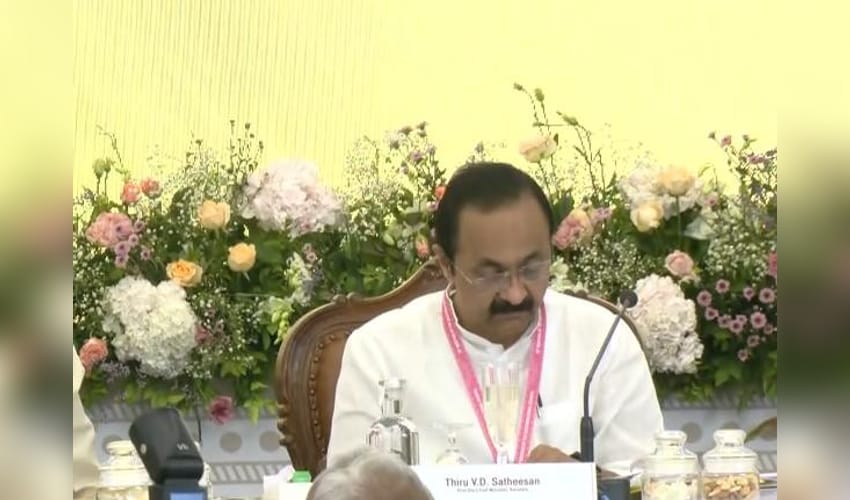

Chennai, Aug 20 (AHN) Kerala Chief Minister V.D. Satheesan on Thursday used the 31st meeting of the Southern Zonal Council, chaired by Union Home Minister Amit Shah, to mount a strong case for greater financial support from the Centre and a more equitable federal framework, flagging a series of issues ranging from healthcare funding and toll charges to coastal erosion, rail connectivity and offshore mining.
The sharpest criticism centred on the Ayushman Bharat health insurance scheme.
CM Satheesan said Kerala had spent around Rs 1,493 crore under the scheme during the last policy year, while the assistance received from the National Health Authority was only about Rs 151 crore, leaving the state to bear nearly 90 per cent of the expenditure.
He sought state-specific premiums instead of a uniform national premium, alignment of eligibility with the National Food Security Act database and a revision of the Central share based on actual expenditure incurred on Centrally-sponsored beneficiaries.
He also sought financial relief for the Kerala State Road Transport Corporation, pointing out that KSRTC had paid more than Rs 2.16 crore in toll charges in June alone despite operating essential public services, including services to remote areas.
CM Satheesan demanded either complete toll exemption for state transport undertakings or substantially concessional rates.
Coastal erosion, which he described as one of Kerala’s gravest climate-related vulnerabilities, was another major issue placed before the Council. With a coastline of around 586 km and nearly 63 per cent of it classified as eroding, CM Satheesan said thousands of fishing families faced recurring loss of homes and livelihoods.
He urged the Centre to permit coastal protection and rehabilitation of erosion-displaced families under disaster response and mitigation funds.
The Chief Minister also sought renewed momentum for the Thalassery-Mysore and Nilambur-Nanjangud railway lines, saying Kerala had completed preliminary work on its side and seeking the cooperation of Karnataka and the Railway Ministry in finalising the alignment and Detailed Project Report.
On restrictions on night traffic through forest stretches connecting Kerala with Karnataka and Tamil Nadu, CM Satheesan opposed blanket bans and called instead for scientifically determined least-sensitive time windows and regulated convoy movement, arguing that wildlife protection and public mobility could be balanced.
Kerala’s concern over offshore sand mining was also firmly reiterated.
While saying the state was cooperating with the Centre in auctioning its bauxite, beach sand and critical mineral blocks, the CM urged that offshore mineral blocks off the Kerala coast should not be auctioned until rigorous scientific assessment and a robust standard operating procedure were put in place.
On the protection of women and children, he said Kerala had operationalised 54 of the 56 sanctioned Fast Track Special Courts, including 14 e-POCSO courts, while compliance with the prescribed investigation timeline had risen to more than 78 per cent.
He sought continuation and assured funding of the Fast Track Special Courts scheme.
CM Satheesan also highlighted Kerala’s performance in child nutrition, anaemia prevention and school retention, and proposed stronger inter-state coordination to tackle narcotics trafficking, organised crime, illegal migration and emerging cyber threats.
He suggested that every southern state designate a senior police officer as an Inter-State Police Nodal Officer to facilitate real-time intelligence sharing, joint operations and coordinated border patrolling.
Presenting the Southern Zonal Council as an important platform for cooperative federalism, CM Satheesan said the southern states should stand together on matters affecting their people while working with the Centre to find mutually beneficial solutions.
The intervention put Kerala’s demand for financial fairness, greater Central support and stronger state autonomy at the centre of its participation in the high-level southern regional meeting.