



Economy
Chinese rocket explodes seconds after launch with communication satellite
Published On Tue, 11 Aug 2026
Asian Horizan Network
4 Views
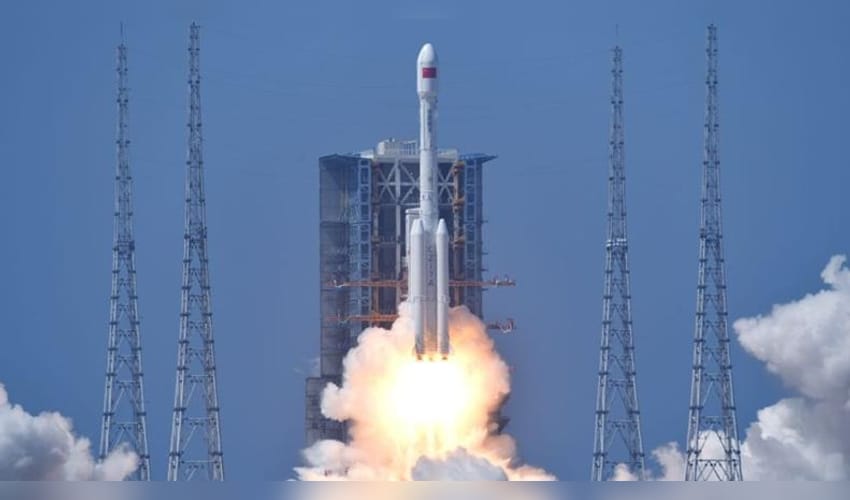

New Delhi, Aug 11 (AHN) A Chinese Long March 7A rocket exploded into a massive fireball seconds after launch, destroying a communications satellite it was intended to take to orbit, a new report has said.
The mid-air explosion marked a "relatively rare failure for a rocket considered a workhorse of Beijing’s space program," the report from CNN said, adding that an investigation is underway into the reason of failure.
The report showed a video of the launch from the Wenchang Space Launch Site on Hainan island on Monday night that showed the rocket breaking apart nearly 85 seconds after liftoff.
"Unlike other successful launches, the incident appears to have been downplayed on China’s state media with scant mention of the explosion," the media house said.
State news agency Xinhua confirmed the failure three hours after the explosion, saying the rocket “experienced an anomaly during flight”.
On Chinese social media such as Xiaohongshu and Douyin, video of the launch was mainly limited to state-affiliated content on Chinese social media, and videos posted from private accounts seemed to be removed or deprioritised from searches.
The rocket was carrying the Zhongxing-4B (ChinaSat-4B) satellite, intended to provide radio, television and other communications services to users around the world, according to state media.
The failure comes as Chinese leader Xi Jinping pursues his ambitions in space, aiming to make China a global leader in space science by 2050. The country is locked in an intense competition with the US on multiple fronts, including reusable launch technology, moon research and satellite launches.
Long March 7A designed by China Academy of Launch Vehicle Technology, a subsidiary of state-owned contractor China Aerospace Science and Technology Corporation, was on its 18th mission when the failure occured. It had only failed previously on one occasion, during its maiden flight in 2020.
—AHN
aar/ag



