



Lifestyle
Article 370 abrogation advanced constitutional equality, social justice: Report
Published On Thu, 06 Aug 2026
Asian Horizan Network
16 Views
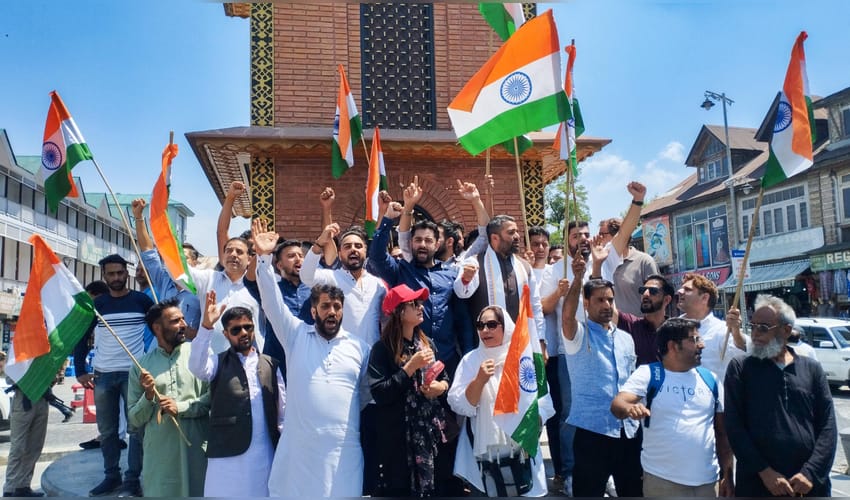

Srinagar, Aug 6 (AHN) The abrogation of Article 370 should be remembered not only as a landmark decision for national integration but also as a significant step towards fulfilling the vision of social justice enshrined in the Indian Constitution, according to a recent report.
The observations were made in an opinion article authored by BJP national spokesperson Guru Prakash Paswan and published in Firstpost, which argues that the constitutional changes introduced on August 5, 2019, should be viewed through the broader lens of constitutional equality and equal citizenship rather than only political or territorial considerations.
Article 370 was abrogated on August 5, 2019, after the Central government led by Prime Minister Narendra Modi revoked the Special Status of the erstwhile state of Jammu and Kashmir through a Presidential Order, ending the constitutional provisions that had granted it special autonomy.
On August 6, 2019, the Lok Sabha passed the Bill and the resolution to dismantle Article 370, following Rajya Sabha approval.
The opinion article stated that history often evaluates constitutional milestones through the prism of politics. However, it argued that the most enduring constitutional decisions are those that fundamentally transform the lives of ordinary citizens, describing the abrogation of Article 370 on August 5, 2019, as one such defining moment.
While much has been written about the decision's implications for national integration and security, the article contended that limiting the discussion to those aspects overlooks its deeper constitutional significance. Seven years later, it said, the revocation of Article 370 should increasingly be recognised as a milestone in India's journey towards constitutional equality, social justice and equal citizenship.
According to the opinion piece, public discourse surrounding Article 370 had, for decades, remained centred on questions of identity and politics, while the concerns and aspirations of marginalised communities received comparatively little attention.
The article further stated that the constitutional changes introduced in 2019 enabled the full implementation of the Constitution of India and numerous Central laws in Jammu and Kashmir, thereby extending legal safeguards and welfare measures that had long been available to citizens in the rest of the country.
Among the communities identified as key beneficiaries, the article highlighted Scheduled Tribes, stating that they received stronger institutional recognition, including political reservation through the first Delimitation Commission, which reserved Assembly seats for Scheduled Tribe communities in Jammu and Kashmir.
It also noted that Other Backwards Classes (OBCs) received political reservation in local bodies under the broader constitutional framework, while Safai Karamcharis and other historically disadvantaged communities gained wider access to national labour laws and welfare protections.
The article further argued that although judicial rulings before 2019 had already addressed significant aspects of women's property rights after marriage outside Jammu and Kashmir, the post-2019 constitutional framework ensured that women in the Union Territory are governed by the same constitutional guarantees applicable across the country.
"The story of Article 370 is, therefore, no longer simply about its abrogation. It is about the expansion of constitutional morality. It is about replacing exceptionalism with equality. It is about extending the guarantees of justice, liberty, equality and fraternity to every citizen without distinction. Most importantly, it is about moving one step closer to Dr Ambedkar's dream of a republic where the Constitution protects every citizen equally -- not because of where they live, but because they are citizens of India," Paswan wrote in the article.
Article 370 became part of the Constitution of India when it came into force in 1950. Since its inception, it remained one of the most debated constitutional provisions because it granted Special Status to the erstwhile state of Jammu and Kashmir.
On August 5, 2019, the provision was rendered inoperative, and Jammu and Kashmir was simultaneously reorganised into two separate Union Territories -- Jammu and Kashmir, and Ladakh -- bringing an end to its earlier constitutional status.



