



Politics
Amrit Prayas conclave focuses on unlocking growth potential of 'Middle India'
Published On Sat, 06 Jun 2026
Asian Horizan Network
3 Views
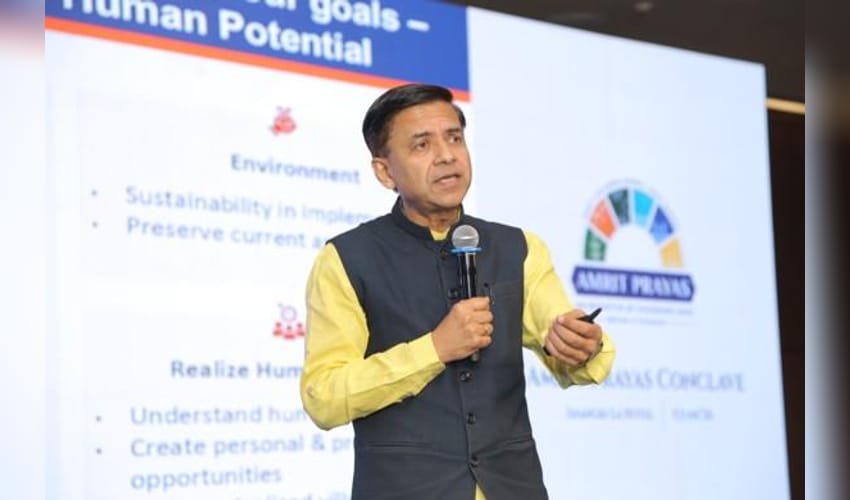

New Delhi, June 6 (AHN) Senior leaders from industry, government, and policy institutions gathered at Shangri-La, New Delhi, for the Amrit Prayas Conclave, an invitation-only forum that placed “Middle India” -- India’s long-overlooked districts -- at the centre of the country’s investment and development agenda.
Organised under Amrit Prayas, a decade-long economic development initiative for the Deoria Lok Sabha constituency, the conclave brought together corporate leaders, policymakers, and institutional stakeholders from sectors including healthcare, tourism, education, skilling, manufacturing, and agriculture. Discussions focused on strategies to unlock district-level growth and create sustainable development models that can be replicated across the country.
Delivering the Vision Address, Shashank Mani, Member of Parliament from Deoria, outlined a district-centric development framework aligned with Prime Minister Narendra Modi’s vision of Viksit Bharat and the principle of “Sabka Prayas” -- collective effort as the foundation of national transformation.
He described Amrit Prayas as a structured platform that brings together government, industry, and citizens to co-create economic growth and social progress.
Mani said the initiative draws strength from the policy support and institutional backing of both the Central Government and the Uttar Pradesh Government. He noted that sustained efforts to improve infrastructure, enhance ease of doing business, and promote balanced regional development have created favourable conditions for districts such as Deoria to emerge as new engines of growth.
Emphasising the importance of janbhagidari (people’s participation), he said the success of Amrit Prayas depends on active community involvement -- from farmers adopting modern agricultural practices and youth participating in skilling programmes to local stakeholders shaping development outcomes.
“This is not growth delivered to a district; it is growth built with the district,” Mani remarked, highlighting the shift from beneficiary-based development models to participatory and locally driven growth frameworks.
A key highlight of the evening was a panel discussion titled “Investment in Middle India”, featuring industry and government leaders Masoom Ali Sarwar, William Bessel, J.D. Giri, and Sheetal Arora.
The discussion examined how coordinated efforts between the Centre and states can reduce investment risks in emerging districts and how policy support, infrastructure development, and local implementation capacity can together create attractive investment destinations.
Delivering special remarks, Saurabh Garg, IAS, Secretary, Ministry of Statistics and Programme Implementation (MoSPI), underscored the crucial role of districts in achieving India’s long-term economic aspirations. He highlighted the importance of data-driven governance, institutional convergence, and private-sector participation in translating national development goals into tangible local outcomes and noted that initiatives such as Amrit Prayas can serve as important catalysts in this process.