



World
The Malacca Gambit: China Oil Choke point Strategy and Its Risks for Trump.
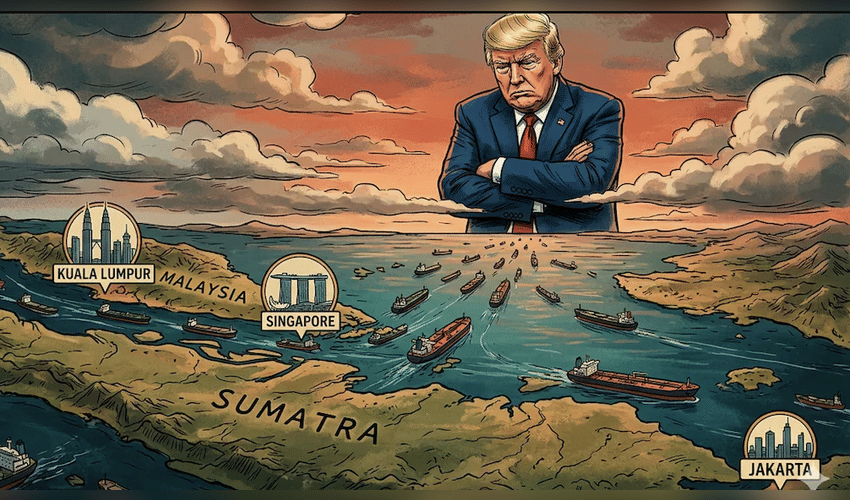

China’s growing reliance on imported energy has placed the Strait of Malacca at the center of its strategic calculations. A significant portion of China’s oil imports passes through this narrow maritime corridor, making it both a lifeline and a vulnerability. In response, Beijing has explored ways to reduce its dependence on the strait, including overland pipelines, diversification of supply routes, and expanding its naval presence. This broader approach is often described as the “Malacca Gambit”—a strategy aimed at securing energy flows while mitigating exposure to disruption.
At the same time, tensions with the United States have amplified the geopolitical stakes of this chokepoint. During the presidency of Donald Trump, trade disputes and strategic rivalry with China raised concerns about potential efforts to pressure Beijing through maritime control. In theory, the U.S. and its allies could leverage their naval dominance to disrupt critical shipping lanes in a conflict scenario. This possibility has driven China to accelerate efforts to safeguard its energy security, including investments in ports and infrastructure across Asia and beyond.
However, analysts argue that China’s focus on the Malacca dilemma could also create unintended consequences. Efforts to bypass or secure the strait—such as building alternative corridors through politically sensitive regions—carry high financial costs and geopolitical risks. Moreover, expanding military presence in key waterways may heighten regional tensions, prompting countermeasures from neighboring countries and rival powers. Rather than eliminating vulnerability, these moves could expose China to new forms of strategic pressure.
For Washington, the situation is equally complex. While the Malacca chokepoint presents a theoretical leverage point, using it aggressively could disrupt global trade and harm U.S. allies who depend on the same routes. This makes any “oil choke” strategy difficult to execute without broader economic fallout. As a result, what appears to be a powerful geopolitical tool may ultimately prove impractical, highlighting how interdependence in global energy and trade networks can limit even the most ambitious strategic gambits.
Disclaimer: This Image is taken from The Hawk.