



News
The Classroom as a Border: How China Uses Mandarin to Suppress Minority Identity
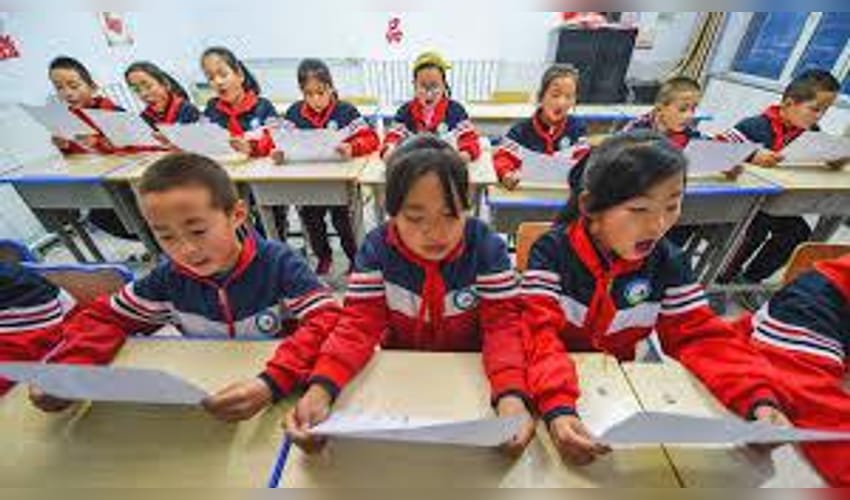

The first place a people disappear is not always a prison, a battlefield, or a demolished shrine. Sometimes it is a classroom, where a child who once named the world in Tibetan, Uyghur, Mongolian, Kazakh, or another mother tongue is told that success, loyalty, and even safety now speak only in Mandarin. In today’s China, language policy is no longer only about communication. It has become a political instrument. Under the language of “ethnic unity,” “national rejuvenation,” and “common identity,” the Chinese Communist Party (CCP) is using Mandarin, or Putonghua (普通话), as a vehicle to reshape minority societies from within: their schools, their religious spaces, their family memory, their public signs, and ultimately their sense of who they are.
China officially recognises 56 ethnic groups, including the Han majority and 55 minority nationalities. On paper, the People’s Republic of China has long claimed to protect minority languages. Article 4 of China’s Constitution says that all ethnic groups have the freedom to use and develop their own spoken and written languages. China’s Regional Ethnic Autonomy Law similarly states that autonomous areas should guarantee the freedom of minority nationalities to use and develop their languages and preserve customs. But the lived reality in Xinjiang, Tibet, Inner Mongolia, and other minority regions tells a different story.
The CCP’s current policy direction is built around the phrase zhonghua minzu gongtongti yishi, usually translated as “a strong sense of community for the Chinese nation.” In practice, this concept increasingly means that minority identity is tolerated only when it is decorative, controllable, and subordinate to a Han-centric national identity. The turning point became sharper under Xi Jinping. The state’s older language of “regional autonomy” has been steadily overshadowed by “integration,” “ethnic unity,” “Sinicization,” and “national security.” The result is not equal citizenship. It is assimilation dressed as harmony.
In March 2026, China passed the Law on Promoting Ethnic Unity and Progress, or Minzu Tuanjie Jinbu Cujin Fa (民族团结进步促进法). According to Reuters, the law will come into force on 1 July 2026 and requires Mandarin to be the basic language of instruction in schools and for government and official business. It also states that where Mandarin and minority languages appear together in public settings, Mandarin must be given prominence in placement and order. This is highly significant. It converts what has already been happening in Tibet, Xinjiang, and Inner Mongolia into a national legal framework.
Beijing presents the law as a way to promote unity and development. But human rights groups warn that it provides legal cover for forced assimilation, including the erosion of minority language rights and intensified ideological control. The law is relevant today because it makes language hierarchy official. It does not simply say Mandarin is useful. It says Mandarin comes first. It does not merely encourage a shared language for practical communication. It places minority languages in a secondary position within education, administration, signage, and public life.
Language is part of that system. In September 2023, UN experts expressed concern over reports that Uyghur children were being separated from their families through an expanding state boarding school system, where they reportedly had little or no access to education in the Uyghur language. This matters deeply. A child’s mother tongue is not just a tool for speech. It is the language of family intimacy, religious memory, humour, grief, prayer, and belonging. When the state separates children from their language, it separates them from the community structures that carry identity across generations.
In Xinjiang, Mandarin-medium education does not operate in a neutral environment. It operates alongside surveillance, criminalisation of religious practice, restrictions on cultural expression, and a political campaign that treats distinct Uyghur identity as a security threat. Tibet reveals the same strategy through education. Human Rights Watch reported in 2020 that China’s “bilingual education” policy in the Tibet Autonomous Region was, in practice, replacing Tibetan with Chinese as the medium of instruction in primary schools, except for classes where Tibetan was studied as a language.
That distinction is crucial. A language taught for one period a day is not the same as a language used to learn mathematics, history, science, ethics, and the world itself. When Tibetan becomes only a subject, while Mandarin becomes the language of knowledge, authority, and opportunity, the state is teaching children a hierarchy: Tibetan belongs at home or in culture; Mandarin belongs to the future. The pressure begins early. In2026, Human Rights Watch reported that Chinese authorities were imposing Chinese-medium education and ideological indoctrination on Tibetan kindergarten children through what it described as a “harmonization” plan.
The symbolism is hard to miss: the state is not waiting until adolescence. It is entering the preschool years, before children can fully understand the political meaning of what is being taken from them. The boarding school system has intensified these fears. In February 2023, UN experts said they were alarmed by
Beijing argues that boarding schools provide modern education to children in remote areas. Education access is indeed important. But access should not require cultural severance. A rights-respecting state can build schools without weakening mother tongues, separating children from family culture, or converting education into ideological remoulding. The issue is not whether Tibetan children should learn Mandarin. Many minority families understand the economic value of Mandarin. The issue is whether Mandarin is being added to their identity or used to replace it.
The CCP’s treatment of Tibetan language advocacy also exposes the political nature of the policy. Tashi Wangchuk, a Tibetan language rights advocate, was detained in 2016 after speaking publicly about the right of Tibetans to study in their mother tongue. Human Rights Watch reported that he explicitly said he was not calling for Tibetan independence, yet he was charged with “inciting separatism” and later sentenced to five years in prison. That case sends a chilling
When a state treats mother-tongue advocacy as a security threat, it is no longer merely promoting a national language. It is policing identity.
Inner Mongolia provides another important example. In 2020, authorities moved to reduce Mongolian-medium instruction by requiring key subjects to be taught in Mandarin. Human Rights Watch reported that the policy triggered school boycotts and protests, followed by detentions and pressure on activists. Reuters also reported rare protests by ethnic Mongolians over curriculum changes that removed Mongolian language from core subjects.
This shows that the pattern is not limited to Xinjiang or Tibet. It is a broader national strategy: weaken minority languages in education, frame resistance as instability, then justify enforcement in the name of unity. The phrase “ethnic unity” sounds peaceful. In Mandarin, minzu tuanjie (民族团结) suggests solidarity
This is why the ethnic unity law is so dangerous. It turns assimilation into civic duty. It links language, religion, education, marriage, migration, housing, tourism, and culture to the creation of a single national consciousness. Reuters reported that the 2026 law also includes provisions on religious Sinicization and warns of legal consequences for domestic or foreign individuals or organisations seen as undermining ethnic unity or promoting separatism. provisions are broad and politically elastic. In China’s legal system, vague language often becomes a tool of fear.
A teacher who wants more Tibetan-medium instruction, a Uyghur parent concerned about boarding schools, a Mongolian student protesting curriculum changes, or a diaspora activist documenting cultural loss can all be portrayed as threatening “ethnic unity.” This is cultural suppression through law. It does not always look like the burning of books or the banning of a language overnight. It is more bureaucratic and more enduring. First, the state changes the curriculum. Then it changes the language of exams. Then it changes teacher training.
Then it changes public signs. Then it closes or pressures private schools that preserve minority culture. Then it punishes those who object. Finally, it claims that the decline of minority language use is natural, modern, and voluntary. But forced hierarchy is not voluntary. When Mandarin is made the language of exams, government employment, political loyalty, urban mobility, and social survival, minority families are placed under pressure to choose between cultural continuity and their children’s prospects. That is not free choice. It is state-engineered assimilation.
The CCP often defends Mandarin promotion as necessary for development. Of course, learning Mandarin can help minorities access higher education, jobs, and wider communication. No serious human rights argument opposes multilingualism. The problem is not Mandarin itself. The problem is Mandarin supremacy. A just policy would allow Uyghur,Tibetan, Mongolian, Kazakh, Korean, and other minority children to become fluent in Mandarin while remaining fully literate and educated in their mother tongues. Many countries manage multilingual education. China has the resources to do so. What it lacks is political willingness, because minority languages carry histories and loyalties that the party cannot fully control.
Language is also tied to religion. In Xinjiang, Uyghur is connected to Islamic scholarship, oral tradition, family rituals, poetry, and memory. In Tibet, Tibetan is inseparable from Buddhist learning, monastic culture, and a civilisational identity that predates CCP rule. For the party, these languages are not merely linguistic systems. They are alternative moral worlds. By prioritising Mandarin and Sinicized political education, the CCP seeks to make the party-state the central source of meaning. This is why the campaign is relevant today.
The 2026 ethnic unity law does not appear in isolation. It arrives after years of experimentation in minority regions. Xinjiang became a laboratory of securitised assimilation. Tibet became a laboratory of boarding schools and ideological education. Inner Mongolia became a test case for reducing mother-tongue schooling. The new law nationalises the logic behind these policies. It also matters internationally. China is not only suppressing languages at home; it is trying to control how these issues are discussed abroad. The ethnic unity framework includes warnings against forces that allegedly undermine national unity.
This can affect diaspora communities, researchers, journalists, and human rights defenders who speak about Uyghur, Tibetan, Mongolian, or other minority rights. The world must be clear: protecting minority languages is not separatism. Teaching a child in her mother tongue is not extremism. Defending Tibetan, Uyghur, or Mongolian cultural life is not an attack on China’s people. It is a defence of human dignity. China’s own constitution promises minority groups the freedom to use and develop their languages. International human rights standards also protect cultural and linguistic rights.
The contradiction is therefore not between minorities and China’s legal order. The contradiction is between the CCP’s constitutional promises and its
That is why Mandarin imposition must be understood as more than education reform. It is a political project to reshape minority peoples into manageable subjects of the party-state. The CCP calls it unity. But unity without equality is domination. Development without cultural freedom is coercion. A shared national future built on the weakening of minority languages is not harmony. It is erasure by policy.
The demand should be simple: China must allow minority children to learn Mandarin without losing their mother tongues; it must protect genuine bilingual and multilingual education; it must stop treating cultural rights advocacy as separatism; and it must repeal or revise laws that make “ethnic unity” a weapon against identity. A state confident in its legitimacy does not fear a child learning history in Tibetan, speaking Uyghur with dignity, or studying Mongolian as a living language. Only a state that confuses control with unity sees diversity as a threat.
Disclaimer : This image is taken from The Economist.



