



News
CISF And Indian Army Deepen Counter-Drone Shield For Airports And Critical Infrastructure
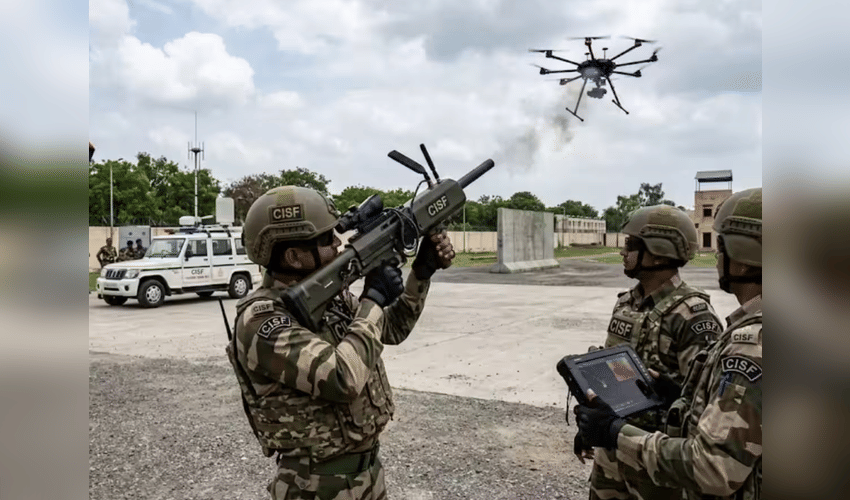

India is strengthening its counter-drone security capabilities as the Central Industrial Security Force (CISF) and the Indian Army deepen cooperation to protect airports and other critical infrastructure from emerging aerial threats. The initiative aims to improve the country's preparedness against unauthorised drone activities, which have become an increasing security concern due to their potential use in surveillance, smuggling, sabotage and attacks on sensitive installations.
Under the collaboration, the Indian Army is providing specialised training to CISF personnel to improve their ability to identify and respond to drone-related threats. The programme focuses on counter-drone operations, perimeter security, protection of sensitive locations and emergency response procedures. In July 2026, the Indian Army's Spear Corps conducted a two-week training programme for CISF personnel deployed at Maharaja Bir Bikram (MBB) Airport in Agartala. The programme, organised at Agartala Military Station, included practical and theoretical sessions aimed at strengthening aviation security preparedness. The training was completed on August 8.
The CISF is also expanding its counter-drone capabilities through partnerships with leading technical institutions. On October 30, 2026, the force signed a Memorandum of Understanding (MoU) with TiHAN, the Technology Innovation Hub on Autonomous Navigation at IIT Hyderabad. The agreement is aimed at developing expertise in drone operations, autonomous systems and anti-drone technologies.
The collaboration also supports the proposed establishment of a Centre of Excellence for Drone and Anti-Drone Technology at the CISF Recruit Training Centre in Behror, Rajasthan. The CISF signed an agreement with the National e-Governance Division (NeGD) on October 23 to provide structured training in emerging security technologies. The programme covers drone operations, counter-unmanned aerial systems, artificial intelligence, autonomous technologies and cybersecurity.
Union Home Minister Amit Shah had earlier announced in March 2026 that the CISF would act as the nodal agency for drone security at critical infrastructure installations, including airports, ports and industrial facilities. The growing focus on counter-drone protection comes as security agencies face new challenges from increasingly accessible unmanned aerial vehicles. Small drones can be used to monitor sensitive locations, interfere with aviation operations or potentially carry dangerous materials.
At airports, unauthorised drone activity can disrupt flight operations and create risks for aircraft, passengers and ground personnel. Similar threats at power plants, ports and industrial facilities could affect essential services and national security. To address these challenges, security agencies are focusing on a combination of specialised personnel training, surveillance technologies and improved coordination between different organisations.
The CISF-Army partnership reflects India's broader effort to modernise infrastructure protection and prepare security forces for technology-driven threats. As drone technology continues to evolve, strengthening detection and response capabilities is expected to remain an important part of the country's security strategy.
Disclaimer: This image is taken from Economic Times.