



Military
BDL Wins DRDO Deal for Innovative Hybrid UAV/UUV Capable of Both Air and Water Operations
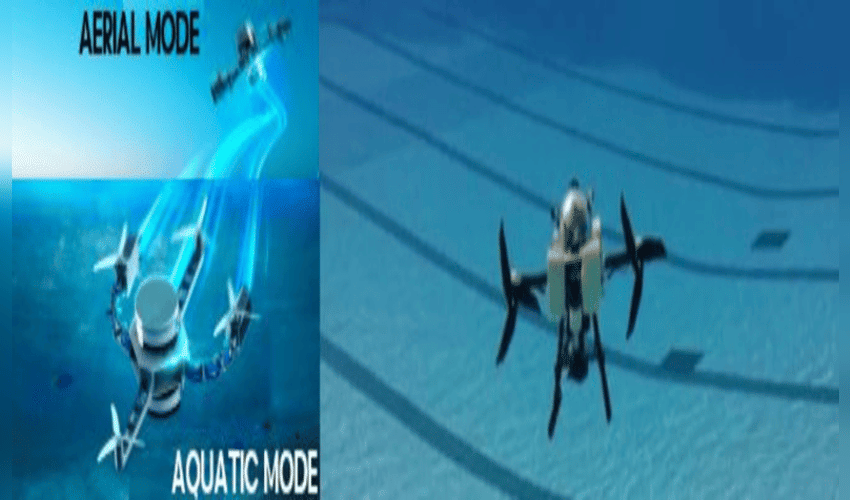

Bharat Dynamics Limited (BDL), a prominent defence public sector enterprise, has been awarded a major contract by the Naval Science and Technological Laboratory (NSTL) under the Defence Research and Development Organisation (DRDO) to design and develop a cutting-edge Aquatic-Aerial System.
This groundbreaking platform integrates the functionalities of an unmanned aerial vehicle (UAV) and an unmanned underwater vehicle (UUV), allowing seamless transitions between aerial flight and underwater operations. The collaboration represents a significant leap forward in strengthening India’s maritime surveillance and reconnaissance capabilities.
BDL won the contract through a competitive tender process, successfully clearing the technical evaluation alongside Aquaarix Autonomous Systems, and was declared the lowest bidder (L-1) with a bid of ₹69,15,272, highlighting both cost-effectiveness and technical proficiency. The company will now lead the prototyping and integration phases in close partnership with NSTL.
The Aquatic-Aerial System marks a transformative step in dual-domain unmanned technology, moving beyond conventional single-medium platforms. Designed for intelligence, surveillance, and reconnaissance (ISR) missions, it enables covert underwater operations followed by aerial reconnaissance without requiring separate systems. Its versatility is expected to be highly valuable for the Indian Navy in diverse maritime scenarios.
Key features include stealth technology to minimize radar, acoustic, and infrared signatures in both air and water domains, leveraging NSTL’s expertise in low-observable designs. Advanced sonar imaging, similar to that used in NSTL’s High Endurance Autonomous Underwater Vehicle (HEAUV), supports high-resolution underwater mapping, obstacle avoidance, and target detection in challenging conditions. Modular payload options allow customization for missions including anti-submarine warfare (ASW), mine countermeasures (MCM), and oceanographic surveys.
The system employs acoustic modems for underwater communication, while ultra-high frequency (UHF), C-band, and satellite communication (SATCOM) facilitate aerial operations, validated during HEAUV lake trials in March 2025. Navigation integrates NavIC and GPS for precise autonomous operations in contested environments. Electro-optic/infrared (EO/IR) cameras and X-band radars enhance surface and aerial ISR capabilities.
This initiative supports India’s Atmanirbhar Bharat vision, fostering indigenous defence innovation and self-reliance. NSTL’s experience with platforms like the Varunastra heavyweight and Shyena lightweight torpedoes ensures confidence in tackling challenges such as power optimization for extended endurance and smooth air-to-water transitions. Collaboration opportunities with partners like Garden Reach Shipbuilders & Engineers (GRSE) could accelerate deployment.
For the Indian Navy, this system expands operational flexibility, including potential submarine-launched missions that evade detection while delivering real-time intelligence. It addresses critical gaps in cross-domain ISR, increasingly important amid rising maritime threats in the Indian Ocean Region. Successful development could enable swarm operations or integration with manned assets, bolstering national security. BDL’s L-1 selection underscores its growing role beyond missiles into unmanned systems and highlights effective public-private collaboration in defence R&D. With the contract formalized in late 2025, prototyping and trial milestones are expected shortly, reinforcing India’s strategic push toward autonomous technologies and blue-water naval superiority.



