



News
A Parasite in Search of a Host: Pakistan woos Bangladesh
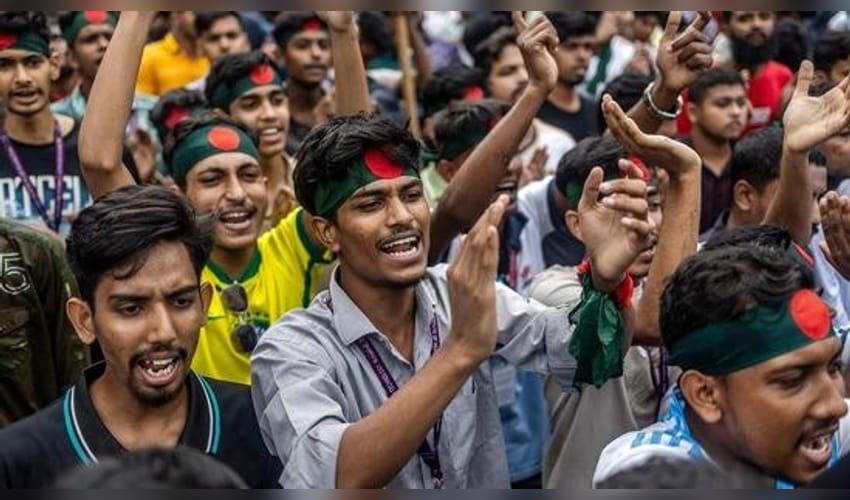

Bangladesh’s Bengali identity remains the bedrock of its statehood, and today the debate surrounding it extends far beyond cultural pride. It is now inseparable from geopolitics. The nation was created through a rejection of West Pakistan’s homogenizing religious project, and this cultural clarity has underwritten Bangladesh’s political stability, economic performance, and diplomatic autonomy. Any political warming toward Pakistan especially if cloaked in narratives of
Re-Opening the Identity Trap Bangladesh Escaped
Pakistan continues to approach Bangladesh through an Islamic-identity framework, not out of cultural affinity but strategic calculation. Islamabad knows identity-driven diplomacy is emotionally resonant and can make Dhaka more susceptible to symbolic overtures. The risk for Bangladesh is not cultural engagement but the subtle re-normalization of a framework that encourages Dhaka to downplay its linguistic-nationalist identity the very force that anchored its political consolidation, manufacturing competitiveness, and diplomatic independence, none of which pan-Islamic solidarity ever delivered.
A Persistent Hierarchy in Pakistan’s Strategic Culture
Punjabi-dominated establishment in Pakistan continues to hold hierarchical views that historically shaped its treatment of Bengalis. This is not simply a matter of the past; it remains embedded in bureaucratic memory, defence thinking, and elite discourse. Bangladesh must evaluate Pakistan not through hopeful
Strategic Memory Matters: Forgetting 1971 Is Not Wisdom
While strategic maturity demands that nations move forward, it does not require amnesia. Pakistan has never meaningfully acknowledged its actions in 1971. Its textbooks still distort the war. Its political elites seldom accept historical responsibility. Without accountability, there can be no structural trust. Bangladesh would be unwise to assume that the same establishment that denied its identity for decades now sees Dhaka as an equal sovereign partner.
Pakistan’s Economic Decline Offers Bangladesh No Strategic Upside
The more central issue is economic reality. Pakistan today is experiencing structural decline. It is not a rising power, not an emerging economic hub, and not a knowledge-driven market. Bangladesh now larger in GDP (PPP), stronger in export competitiveness, and performing better on nearly all socio-economic indicators has no rational incentive to integrate strategically with a state in deep fiscal and institutional distress. Pakistan’s economic fragility is stark:
· GDP per capita (2023): Bangladesh ~USD 2,800; Pakistan ~USD 1,470
· Foreign reserves: Pakistan has repeatedly hovered near insolvency, requiring IMF bailouts every few years
· Inflation: Pakistan crossed 25–30% repeatedly between 2022–2024
· Exports: Pakistan’s exports remain stagnant at ~USD 30–32 billion, while Bangladesh’s exceed USD 52–55 billion, driven by competitive manufacturing
· Poverty: Pakistan’s poverty rate rose above 39% in 2023; Bangladesh’s is significantly lower (18.7% in 2022)
· Debt: Pakistan’s external debt has exceeded USD 130 billion with unsustainable repayment cycles
There is little that Pakistan can offer Bangladesh no significant markets, no advanced science or technology, no naval or industrial innovation, and no credible economic partnership. Bangladesh already enjoys deeper cooperation with the EU, US, Japan, South Korea, China, India, and ASEAN nations partners that bring capital, technology transfers, and strategic stability. Pakistan offers none of these. There have been a string of high profile exits by major international companies from Pakistan in the recent years such as Shell, Total Energies, Proctor & Gamble, Pfizer, Bayer, Microsoft just to name a few.
The exodus of a broad swathe of multinational firms across unrelated sectors suggests that Pakistan’s economic deterioration currency volatility, inflation, import-dependency, regulatory unpredictability has significantly undermined its attractiveness for global investors.Bangladesh gains nothing economically, scientifically, or strategically from engagement with a state whose macroeconomic foundations are eroding. Pakistan cannot offer technology cooperation, supply chains, investment, or a stable market. Instead, Dhaka risks reputational drag, investor uncertainty, and association with a fragile economy heavily scrutinized by the IMF and FATF.
Pakistan’s international image is further weakened by persistent terrorism, political volatility, and governance failures. Its passport ranks 10 places below
When Outreach Serves Self-Interest—Not Partnership
Pakistan’s renewed friendliness toward Bangladesh is not an act of reconciliation. It is strategic calculus. In South Asia’s evolving geopolitics, Islamabad seeks Dhaka primarily as a hedge against India. The cultural and religious rhetoric is merely a softening device. Pakistan sees Bangladesh as a card to be played, not a partner to be empowered.
Here the analogy to the Melian Dialogue is striking. Like Athens, Pakistan does not approach Bangladesh out of goodwill but out of perceived necessity, driven by insecurity and regional isolation. Bangladesh, in Pakistan’s imagination, is the Melos: a smaller state to be coaxed or pressured into alignment for Islamabad’s geopolitical convenience.
The Illusion of Religious Brotherhood
Pakistan’s historical reliance on religious fraternity as a diplomatic tool has yielded neither economic nor political dividends. For Bangladesh, such rhetoric offers only downside:
· No access to new markets.
· No technological collaboration.
· No leverage in global platforms.
· No shared scientific ecosystem.
· No stable investment flows.
Bangladesh’s rise has been built not on religious alliances but on economic pragmatism: export-led growth, women’s workforce participation, rural development, microfinance ecosystems, and a globally integrated garment industry. Pakistan is unable to support or complement any of these pillars. If Dhaka were to embrace Pakistan’s overtures uncritically, it risks being pulled into a geopolitical orbit defined by instability and diminishing influence. Pakistan’s
The Larger Strategic Calculus
Bangladesh’s strategic horizon economic corridors to ASEAN, blue economy prospects in the Bay of Bengal, climate resilience partnerships, maritime capacity-building, and engagement with Indo-Pacific powers requires stable, forward-looking partners. Pakistan’s geopolitical interests, heavily constrained by its India and Afghanistan fixation and domestic crises, are fundamentally incompatible with Bangladesh’s growth trajectory. Simply put: Bangladesh’s rise is powered by economic logic. Pakistan’s outreach is driven by geopolitical survival. These two paths do not converge.
Seeing the Trap for What it is
Bangladesh must view Pakistan’s outreach with clarity, not sentiment. The engagement on offer is not cultural reconciliation, not regional balance, and not economic partnership it is an attempt by a weakened state to regain relevance through symbolic diplomacy. Bangladesh’s future rests on strategic autonomy, economic strength, and partnerships grounded in stability and capability. Pakistan offers none of these. Dhaka should not risk its trajectory for the illusion of fraternity or for the geopolitical calculations of a state struggling to hold itself together.
This image is taken from Hindustan Times.



