



Asia In News
From opposition to obstruction: Congress undermined India on world stage?
Published On Fri, 20 Feb 2026
Asian Horizan Network
57 Views
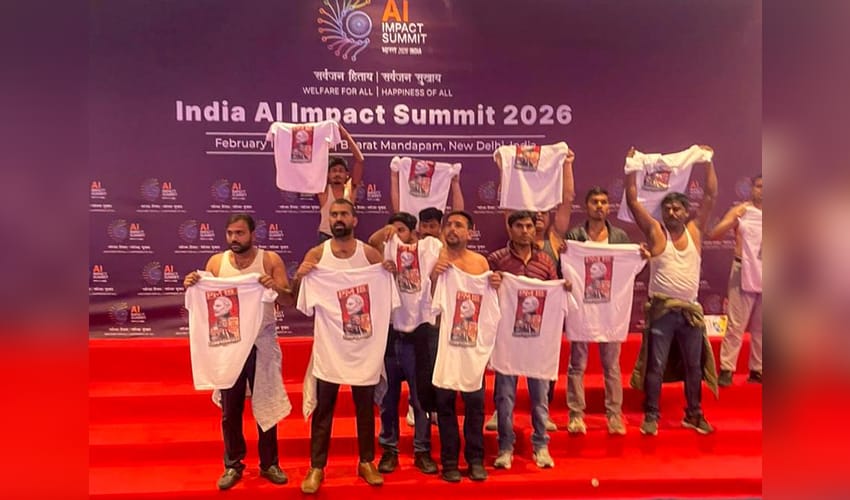

New Delhi, Feb 20 (AHN) The atmosphere at the AI Impact Summit in Bharat Mandapam shifted dramatically on Friday afternoon when a group of protesters, linked to the Indian Youth Congress (IYC), stormed the venue.
As global tech leaders, policymakers, and investors gathered to discuss Artificial Intelligence, the protesters raised slogans against Prime Minister Narendra Modi and the proposed India-US trade deal. Some demonstrators reportedly appeared semi-clad, holding or wearing T-shirts bearing phrases such as “PM is compromised” and “India-US trade deal”.
The summit, conceived as a platform to showcase India’s growing technological prowess, became the backdrop for a sharp domestic political confrontation, say reports. International delegates, including CEOs of multinational firms and representatives of global media houses, witnessed a scene that many observers described as “a collision between India’s innovation narrative and its electoral contestations.”
Political analysts were quick to describe the incident as a “miscalculated choice of venue”. An analyst remarked, “Protest is intrinsic to democracy. But context shapes legitimacy. When a nation is hosting an international technology summit, the stage is not merely domestic -- it is diplomatic.”
The AI Impact Summit was positioned as India’s statement to the world: that it is not merely a market for technology, but a producer and shaper of it. “In that moment, the country was presenting itself as a technological leader. The protest shifted the spotlight from AI policy to political acrimony,” says an observer.
Critics argued that raising issues related to a bilateral trade deal at a technology forum blurred thematic lines. “If the grievance concerns the India-US trade agreement, then Parliament, press conferences, or organised rallies are more coherent platforms,” said a senior political analyst. “Conflating unrelated issues risks diluting the seriousness of both.”
The method of protest drew even sharper reactions. Footage suggesting semi-nude sloganeering prompted outrage across sections of social media and political commentary. Many commentators described the act as “indecorous” and “an embarrassment on a global stage”.
Critics termed the act as something reflective of what they called a “poverty of ideas”.
One commentator wrote that such “spectacle politics” signalled ideological exhaustion. Another argued that opposition parties must distinguish between robust dissent and what he termed “self-defeating theatrics”.
India’s democratic vibrancy has long been cited as one of its strengths. “The right to protest is constitutionally protected and historically celebrated,” said a political observer. “However, democratic rights coexist with strategic considerations. A global summit is both a domestic and international event.”
Analysts contended that opposition to the ruling party -- or even to the Prime Minister -- is legitimate but must not translate into what they described as “national embarrassment”.
One analyst observed, “Oppose the government, critique policy, challenge trade agreements -- but do not conflate partisan resistance with the country’s global representation. International forums are delicate ecosystems.”
For the broader opposition ecosystem, the episode has triggered introspection. An analyst suggested that dramatic protests often arise from a perceived loss of political space.
“When conventional channels feel ineffective, movements resort to symbolism. The question is whether such symbolism mobilises support or alienates the undecided middle,” says an analyst.
Some critics have argued that instead of amplifying their message, the protest may have overshadowed substantive concerns about trade negotiations. “The debate shifted from the content of the India-US deal to the conduct of the protesters,” said a politician. “In media politics, optics often trump argument.”
The AI Impact Summit was intended as a declaration of India’s digital ambition -- a moment to project confidence and competence. Instead, it briefly became a tableau of domestic polarisation.
The deeper question, as several observers noted, is not merely about one protest. It is about political culture. “Democracy thrives on disagreement, but it also demands discernment -- about place, method, and moment”.



