



Economy
Food processing levels in India rose to 17 pc by 2023, report released at 'SAPLING 2026'
Published On Tue, 09 Jun 2026
Asian Horizan Network
79 Views
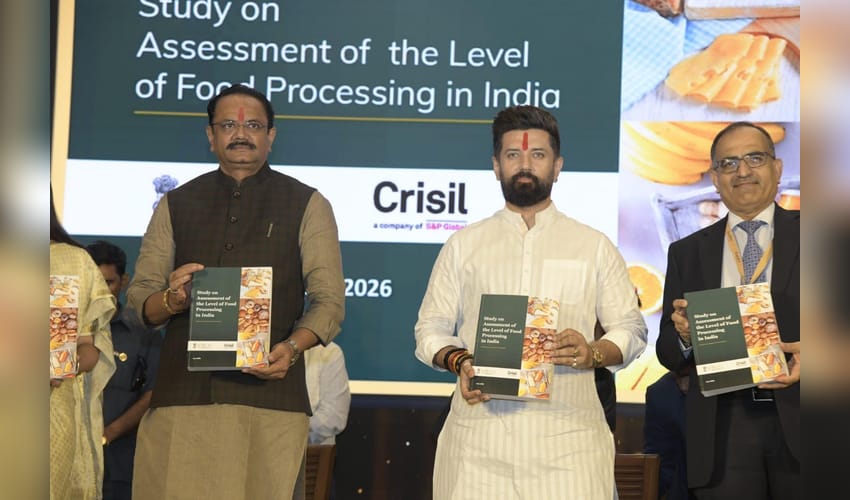

Ahmedabad, June 9 (AHN) Union Food Processing Industries Minister Chirag Paswan on Tuesday inaugurated the SAPLING (South Asian Policy Leadership for Improved Nutrition and Growth) Dialogue 2026 in Ahmedabad, bringing together policymakers, industry leaders, development agencies, researchers and entrepreneurs from across South Asia to discuss ways to strengthen food processing ecosystems, generate employment and build sustainable food systems in the region.
The two-day regional high-level policy dialogue, titled "Unlocking Value: Advancing Food Processing for Employment Generation and Sustainable Growth in South Asia", is being co-hosted by the Ministry of Food Processing Industries (MoFPI) and the World Bank Group-led SAPLING initiative.
Around 200 participants, including representatives from South Asian countries, startups, innovators, development partners and research institutions, are attending the event, which focuses on strengthening food processing value chains and promoting resilient and inclusive growth.
Addressing the inaugural session, Paswan said food processing had emerged as a crucial link between agriculture and economic prosperity.
"Food processing is the bridge between agriculture and prosperity and has immense potential to generate employment, reduce post-harvest losses, improve farmer incomes, and strengthen food security," he added.
Highlighting India's growing role in the global food processing sector, the Union Minister emphasised the importance of value addition, technology adoption and regional collaboration in transforming South Asia's food economy.
He said that policy initiatives and infrastructure development undertaken by the Union government were helping create globally competitive food value chains.
Gujarat Agriculture Minister Jitu Vaghani welcomed delegates from different countries and described SAPLING 2026 as a significant regional platform.
"The food processing sector could serve as an engine of agricultural transformation and reaffirmed the state government's commitment to promoting agro-industrial development," he said.
Vaghani added that the Gujarat government was committed to fostering the agro-industrial sector as a driver of employment generation, value addition and overall economic growth.
To strengthen links between agriculture and industry, he advocated the establishment of a campus of the National Institute for Food Technology Entrepreneurship and Management (NIFTEM) in Gujarat.
The inaugural plenary was attended by Paul Procee, Acting Country Director for India at the World Bank; Archna Vyas, Country Director for India at the Gates Foundation; and Avinash Joshi, Ministry of Food Processing Industries Secretary.
The dialogue features discussions on key themes, including unlocking South Asia's food processing opportunities, strengthening agricultural supply chains, formalising informal food processors, promoting technology-driven innovation, enhancing food safety and quality standards, mobilising investments and advancing regional policy cooperation.
Senior representatives from organisations including Nestle, Bayer, Rabobank, Ajinomoto, ITC, SEWA, NABARD and Food Industry Asia are participating in the deliberations.
Alongside the dialogue, an Innovation Fair has been organised to showcase emerging solutions in cold-chain logistics, digital traceability, sustainable packaging, smart processing technologies and storage systems.
The exhibition aims to encourage collaboration between innovators, policymakers and industry stakeholders.
During the event, Ministers and dignitaries released the report, "Assessment of the Level of Food Processing in India", by MoFPI.
The report provides a detailed assessment of food processing levels across major agricultural commodities and highlights the growth of India's processing sector, with overall processing levels increasing from around 10 per cent in 2016 to nearly 17 per cent in 2023.
The study identifies significant opportunities for value addition in perishable commodities such as fruits, vegetables and dairy products.
It also outlines policy recommendations aimed at strengthening infrastructure, reducing post-harvest losses, improving farmers' incomes and enhancing India's competitiveness in the global food economy.
The SAPLING Dialogue is aligned with the World Bank Group's AgriConnect initiative and the SAPLING platform, both of which seek to accelerate the development of resilient, nutrition-focused food systems across South Asia through policy reforms, investment mobilisation and technology-driven solutions.
Organisers said the dialogue is expected to promote cross-country learning, strengthen regional cooperation, encourage private investment, support micro, small and medium enterprises, and identify practical pathways for food processing-led employment generation and sustainable economic growth across South Asia.



